




Even though the steering wheel is straight, the car …… flowing left and right.
In such cases, it is easy to think, “Alignment?”, but in fact, there are many cases where it is caused by deterioration of the shock absorber (suspension).
If the shock is weakened, the body will not be able to maintain its posture, and it will shake slightly even when driving straight, resulting in a “flowing feeling”. There are no warning lights and no abnormal noises, so it is a problem that is often overlooked.
In this article, we will explain in detail why the car flows due to suspension failure, how to cause symptoms, DIY checks, and repair costs.
▼Driving problem diagnosis guide▼
👉Comprehensive summary of causes of poor running
- Symptom summary
- There are four main causes (by structure)
- Cause (1): Shock absorber deterioration and straight drive is not stable
- Cause (2): Deterioration of the shock mount (deformation of the upper support rubber)
- Cause (3): Deterioration of the stabilizer link stabilizer bush
- Cause (4): Suspension posture collapses and alignment is out of alignment
- Points that can be checked in DIY
- Is it okay to drive? (Urgency)
- Approximate repair cost
- Related parts to check at the same time
- Conclusion
- What to read next
- Defect details by vehicle type
- Frequently Asked Questions (FAQs)




Symptom summary
- Even if you go straight, it will come to the left and right
- It feels like a car floating at high speed
- There is a lot of “shaking back” after the step
- It is easy to get caught in a rut
- The front tends to sway up and down when stopping
- Tire fragmentation increases
There are four main causes (by structure)
- Deterioration of shock absorbers (most common)
- Damage to shock mounts and rubber deterioration
- Stability Link Stabili Bush Hetari
- Suspension geometry misalignment (worse alignment)
Cause (1): Shock absorber deterioration and straight drive is not stable
When does it happen?
- Fluffy at high speed
- Picking up too much unevenness on the road surface
- Shaking after steps lasts for a long time
Why do I have that symptom?
The shock is a “device that suppresses up and down shaking”.
If this weakens, the tires will not be able to adhere to the road surface and the grip will decrease.
Tires with reduced grip become sensitive to ruts, wind, and road tilt, making
the car appear to flow left and right.
VW cars have a high accuracy of the undercarriage and are prone to shock deterioration in their behavior.
What happens if left unattended?
- Unstable at high speed (dangerous)
- Increased braking distance
- Uneven tire wear increases
Cause (2): Deterioration of the shock mount (deformation of the upper support rubber)
When does it happen?
- “Giggish” and “Bang” on the steps
- Subtle noises at low speeds
- The posture of the car body is not stable
Why do I have that symptom?
The mount is a rubber part that supports the shock.
If it sinks or cracks,
the force of the shock will not be transmitted correctly, and the car body will be easily shaken from side to side when driving straight.
What happens if left unattended?
- Increased noise around the undercarriage
- Reduces overall suspension life
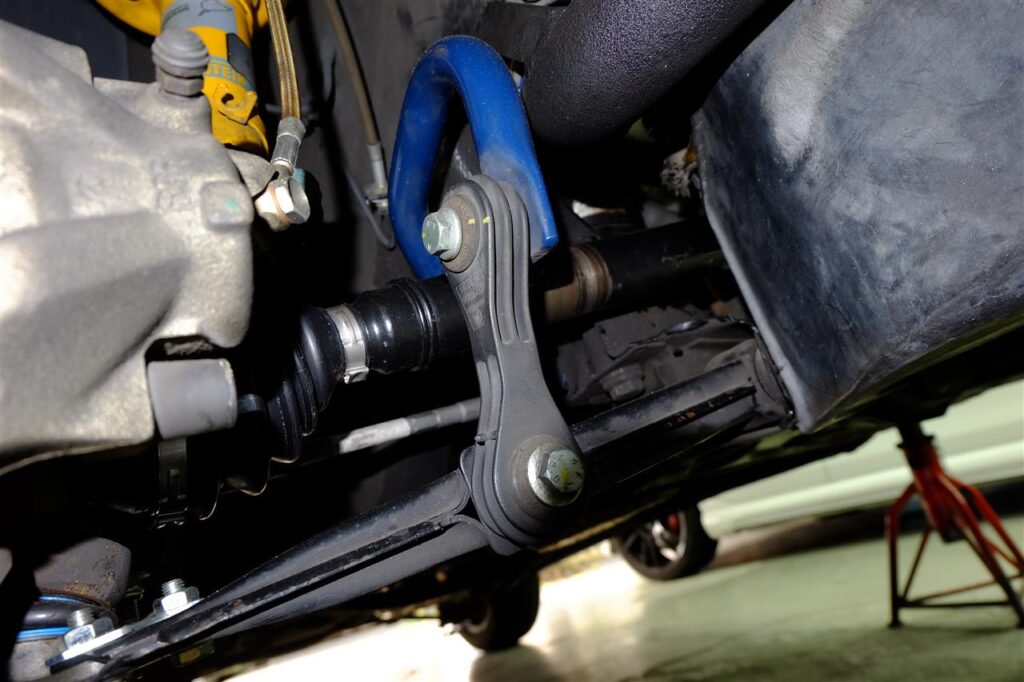
Cause (3): Deterioration of the stabilizer link stabilizer bush
When does it happen?
- Gurgling sound
- Weak sense of stability in curves
- It is easy to be caught in ruts
Why do I have that symptom?
The stabilizer is a device that suppresses the roll (roll) of the car.
When the links and bushings deteriorate,
lateral shaking increases, making it easier for the car body to swing from side to side even when driving straight.
What happens if left unattended?
- Roll gets bigger
- Steering feel worsens
Cause (4): Suspension posture collapses and alignment is out of alignment
When does it happen?
- Tires lose
- Steering wheel center misalignment
- It flows subtly to the side while going straight
Why do I have that symptom?
When the shock is lost, the vehicle height drops,
and the toe angle and camber angle shift, worsening the alignment.
As a result, the tires try to go in a different direction than they should be, causing flow.
What happens if left unattended?
- Worse alignment
- Rapid tire uneven wear
- Significantly reduced high-speed stability
Points that can be checked in DIY
- When stopping, press the body to check the number of times it shakes back
- Align air pressure on the left and right sides
- Whether or not tires are reduced (inward/outward)
- Does it make a sound when overcoming a step?
- Is there a difference in vehicle height?
*It is difficult to determine the deterioration inside the shock with DIY.
Is it okay to drive? (Urgency)
- Can be driven for a while: mild fluffiness
- Risk of worsening symptoms: Stabilizer bush deterioration and mount wear
- Driving NG (towing recommended): Shock oil leak / Uncontrollable level of wobbling at high speed
When a driving problem occurs, it may be necessary to tow the truck depending on the situation.
In these cases, it may be covered by road assistance or riders of automobile insurance, so it is safe to lightly review the contents of your current contract.
If you may not have a proper understanding of the coverage, you can use a comparison service to check the coverage details and premiums of multiple companies at once. Since you can get a complete picture in a short time, many people use it for repairs and inspections.
👉 Free Car Insurance Bulk Quote Service
Approximate repair cost
| Work Description | Approximate cost |
|---|---|
| Shock absorber replacement | 60,000 to 120,000 yen |
| Shock Mount Replacement | 20,000 to 40,000 yen |
| Stabilize link replacement | 10,000 to 20,000 yen |
| Stabilize Bush Replacement | 8,000 to 18,000 yen |
| Alignment Adjustment | 10,000 to 18,000 yen |
| Diagnosis fee | 5,000 to 10,000 yen |
You can scroll
*Shock deterioration is easy to chain with multiple parts, so early inspection is the most advantageous.
👉Summary of maintenance and custom costs & working days of VW specialty store Nile Plus
Related parts to check at the same time
- Lower Arm Bushing
- Tie Rod/Rack End
- Hub Bearings
- Stabilize Link
- Shock mount
- Alignment Angle
- Tire condition
▼List of individual pages about undercarriage repair and maintenance▼
Conclusion
Suspension failure can cause the car to flow from side to side due to deterioration of the shock, damage to the mount, weakening of the stabilizer system, etc., causing the car to flow from side to side.
If left unattended, stability will be lost at high speeds, which will directly lead to uneven wear and deterioration of braking distance. If the ruts and fluffiness increase, it is safe and cost-effective to have the area around the shock inspected as soon as possible.
Even if the symptoms are similar, the causes vary from vehicle to vehicle.
Even if there are similar abnormal noises and malfunctions, there are various causes such as turbo belts and sensors.
If you are unsure, it is safe to have it inspected at a maintenance shop without overdoing it.
What to read next
Please proceed to the article below that best describes your symptoms.
- Steering Wheel Jerks on Bumps? How to Diagnose Undercarriage Rattles and Play
- Steering Wheel Flutter at High Speed: Causes and Loss of Straight-Line Stability
- Steering Wheel Pulls to One Side: Alignment vs Tire Issues and How to Tell
- Car Pulled by Road Surface Bumps? Causes of Tramlining in VW and How to Fix It
- Why Won’t My Car Drive Straight and Why Is It Making Noise? Common Causes Explained
- Causes of increased steering play|If you feel “rattling” on the steering wheel
- Why Doesn’t My Car Track Straight After New Tires? Alignment and Setup Issues Explained
- Car Won’t Track Straight? Symptoms of Worn Undercarriage Bushings and How to Tell
- Why Doesn’t EPS Correct Steering? Straight-Line Instability in VW Without a Warning Light
- Car Feels Floaty or Unstable? Causes of Suspension Failure and Shock Wear Symptoms
Defect details by vehicle type
Although the “way of getting out” the defect is similar, “which model has many problems” is slightly different for each car model.
Trends by vehicle model and common breakdown cases among other owners are summarized on the following page.
Frequently Asked Questions (FAQs)
Q1. If the car flows even though the steering wheel is straight, is it always due to shock?
A. Shock deterioration is a very common cause, but not always. There are other factors such as alignment, tires, and lower arm bushings, which require a comprehensive inspection.
Q2. Can you reliably determine whether the shock is broken by DIY?
A. It is difficult to make a complete judgment. The “trend” can be grasped from the magnitude of the shake back and the behavior on the step, but the internal deterioration cannot be visually seen. Diagnosis in a specialized store is reliable.
Q3. Will replacing the shock make it run straight?
A. If it is caused by deterioration, it will be greatly improved. However, if the mount, stabilizer, and alignment are out of alignment at the same time, the original straight-line stability will be restored by maintaining them together.
Q4. Is it safe to drive even if there is fluffiness or flow while driving?
A. It is possible to drive mildly, but it is more dangerous at high speeds. If it is strongly caught by shock leakage, large fluffiness, or ruts, it is recommended to refrain from driving and inspect.
Q5. If there is a reduction, can it be cured just by replacing the shock?
A. In many cases, in addition to shock degradation, there is also a misalignment. It is certain that the alignment adjustment will be done as a set after the shock replacement.



コメント