


Before reading this content, it will be helpful to check the basic knowledge of DSG to deepen your understanding.
👉 DSG Transmission Basics
“The wrench symbol stays on and the car won’t move even though it’s in D and R” –
anyone would be worried if they suddenly found themselves in this situation one day.
In fact, this problem is not uncommon with the 7-speed dry DSG (model: DQ200) used in Golf, Polo, Passat, etc.
At first glance, it may appear to be a malfunction of the electronic control, but
in reality , in many cases it is caused by a fairly “mechanical” issue: the fork bearing inside the transmission getting stuck .
In particular, if there is a problem with the fork mechanism on the 6th gear R (reverse) side,
even if the meter appears to be in D or R range,
the internal gears will not mesh properly, and the engine speed will just increase but the car will not move .
This phenomenon is more like “the mechanism that keeps the car moving has stopped mid-way” rather than the car breaking down .
If you understand the cause, there is no need to panic.
Also, you can prevent it from happening again by making some adjustments to how you operate the car when it is stopped and how you handle it on a daily basis .
In this article,
- Reasons why it won’t move even in D range
- Internal structure and malfunction mechanism
- Why incorrect operation can cause problems
- Correct stopping and restarting procedures
- Repair costs and first aid methods
We will explain the steps step by step.
We will explain difficult technical terms in an easy-to-understand manner, so
if you drive a vehicle equipped with a DSG or are currently experiencing problems,
please read on with confidence.
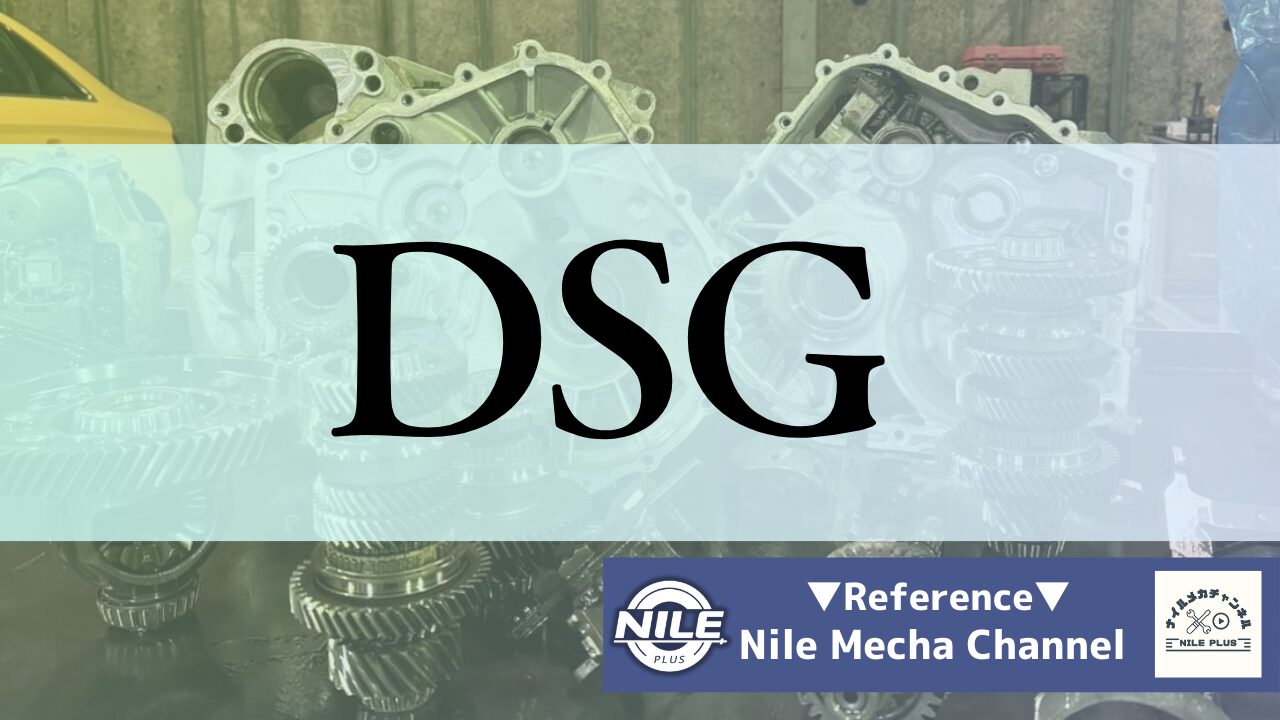
*Reference information: Nile Mecha Channel “DSG trouble that won’t work even with D/R” video
▼Nile Mecha Channel Technical Article Navigation▼
DSG Special Feature
Suspension Special Feature
Engine Special Feature
👉Check out:Nile Mecha Channel (youtube)
Related articles:DSG/Transmission
- Explained: The 6-Speed Wet DSG (DQ250)
- Won’t Move in D Range: Causes of 7-Speed Dry DSG (DQ200) Failure and What to Do
- Does the 7-Speed Dry DSG (DQ200) Need an Oil Change? Costs, Procedure, and Facts
- DQ200 Dry DSG Clutch Guide: Design, Replacement Cost, Judder Symptoms, and Longevity Tips
- Is DSG Judder in the 7-Speed Dry DSG (DQ200) Really Just a Clutch Problem?
- A Complete Guide to the 7-Speed Dry DSG Mechatronics
- Inside the Shop: Rebuilding DSG Mechatronics
- DQ381 Wet DSG Oil Change Guide: When to Service, Cost, Time, and Filter Replacement
- DSG Mechatronics Oil Leak: Causes, Repair Costs, and O-Ring & Gasket Replacement Tips
- Symptoms and Conclusion: The car won’t move even though it can be shifted into both D and R | Typical problems with the 7-speed dry DSG (DQ200)
- First of all: Immediate emergency measures (what to do when the engine starts but won’t move)
- Understanding the mechanism: The basic structure of the 7-speed dry DSG (DQ200) – Understanding why it stops working
- The core cause of the failure: Why does fork bearing “sticking” occur?
- Improvements with countermeasure parts: Why durability improved by replacing bearings with sleeves
- Common mistakes: Do “habits” when parking lead to breakdowns? The mechanism
- Proper stopping procedure – “Stopping habits” that will extend the life of your DSG
- Risk of neglect: The process by which a minor malfunction turns into a major breakdown
- Estimated repair and replacement costs: How much will it cost to fix it? (Parts, labor, and replacement products)
- Frequently Asked Questions (FAQ)
- We also recommend these articles:
- Details of defects by vehicle type


Symptoms and Conclusion: The car won’t move even though it can be shifted into both D and R | Typical problems with the 7-speed dry DSG (DQ200)
🚗 “I can shift into both D and R, but my car won’t move” – a symptom experienced by many owners
After waiting at a traffic light, you put the shift into “D” as usual, but the car won’t move forward.
Even when you put it into “R,” it won’t reverse. Even when you step on the accelerator, the engine speed just increases… This is a problem that is reported relatively often
in vehicles equipped with a 7-speed dry DSG (model: DQ200) .
At first glance, it may appear to be a malfunction of the engine or electronic control system, but
in fact, the cause is that the gears inside the transmission are not physically meshing together .
In other words, even if the driver issues the command to “move,”
the internal mechanical parts are unable to respond to that command.
⚠️ Common signs and behaviors
When this symptom occurs, there are some common characteristics:
- The wrench symbol (yellow tool icon) lights up on the meter.
- The engine starts normally
- When you step on the accelerator, the engine revs
- The shift indicator (D/R) changes, but the gear does not actually move.
- There is almost no vibration or noise
It rarely stops suddenly while driving, but rather occurs
immediately after stopping or when restarting the vehicle .
For example, this typically happens when you stop at a convenience store and are about to leave a few minutes later,
or the moment you restart the engine in a parking lot.
🔍 Why it is often misunderstood as an electronic control problem
When the warning light comes on in the meter, the first thing you might think is, “Is there a sensor malfunction?”
However, in most cases, this is caused by a mechanical jam (fork sticking). In other words, it’s not an electronic signal that’s causing
the “arm”-like part inside the transmission to stop working.
Therefore, even if the shift response appears normal,
the gears are not actually shifting – this is the true nature of the “not working” symptom.
💡 Will it heal naturally if left alone?
If it’s just a temporary jam, it may work if you restart the engine.
However, this is just a case of it “just coming loose by chance.”
If there is internal wear or thermal deformation, it is very likely to recur.
In particular, if the same symptoms occur repeatedly, you should suspect a stuck bearing in the 6th gear/R fork section
, rather than a problem with the mechatronics or clutch .
🧭 First things to know
- If an early inspection is performed, it may be possible to deal with the problem before disassembly and replacement is required.
- In most cases, the cause is a mechanical fork jamming.
- The engine and ECU are operating normally.
First of all: Immediate emergency measures (what to do when the engine starts but won’t move)
If your Volkswagen
is in a situation where it won’t move even though you can shift into both D and R, it’s important to stay calm
. In most cases, this problem isn’t an electronic error, but rather a mechanical issue caused by a stuck fork bearing. There are some cases where you can temporarily restore the car’s function by following a few steps .
Step 1: Shift into “N (Neutral)”
First, shift into N range without turning off the engine .
In this state, the gear will be completely disengaged, making it easier for the load on the internal fork to be released.
Then, step on the brake and make sure the car is completely stationary.
Step 2: Gently rock the car back and forth
With the vehicle in N range, try moving it slightly back and forth. A little
bit of force, like pushing with your hand
, will be enough. This will slightly move the gear teeth that are still engaged,
releasing the fork and bearings from sticking.
In some cases, you may hear a “click” and feel the internal parts move slightly.
Step 3: Start the engine again and operate the D/R.
After shaking it gently, start the engine again and
put it in D or R.
If you’re lucky, the stuck fork may move and you
‘ll be able to start the car normally.
However, this is only a temporary solution .
If there is a problem with the bearings or sleeve inside the fork, the
problem will likely reoccur over time.
🚨 Step 4: If the warning light remains on, do not drive and bring the vehicle into the garage.
If the spanner mark or transmission warning light remains on,
it is important not to try to drive the vehicle.
Driving with unstable hydraulic control can damage the clutch and even the mechatronics.
Choose to have the vehicle towed or take it to a specialist.
Even if you can get it working again after some temporary repairs,
it’s just a temporary loss of power within the machine.
A permanent solution requires inspecting the fork bearings and replacing the sleeves.
To prevent this from happening again, it’s best to have it inspected at a specialist shop as soon as possible.
Understanding the mechanism: The basic structure of the 7-speed dry DSG (DQ200) – Understanding why it stops working
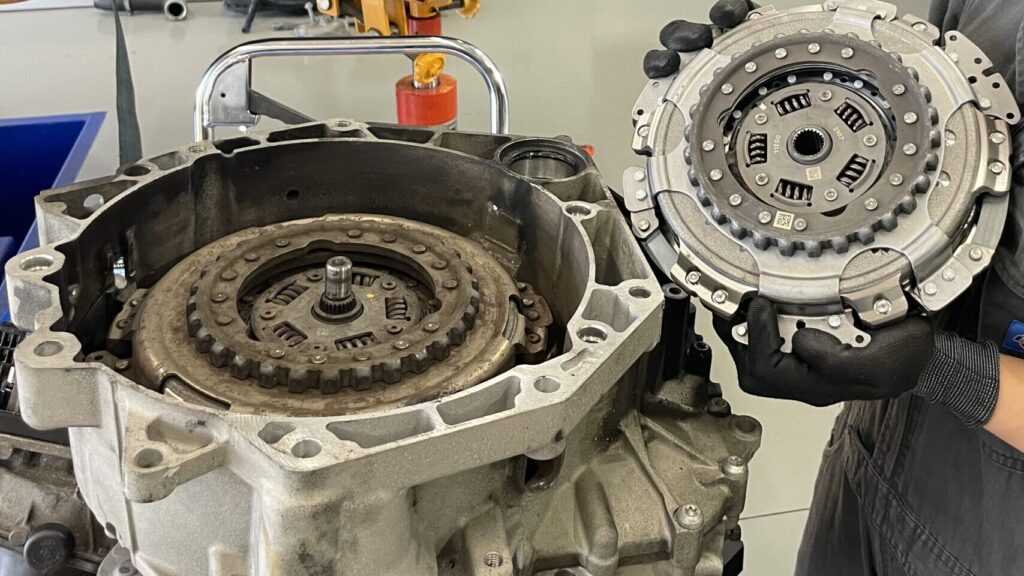
⚙️ What is “DSG”?
DSG (Direct Shift Gearbox) is a dual-clutch transmission developed by Volkswagen .
Unlike a typical automatic (torque converter) transmission, its biggest feature is that it
alternates between two clutches to change gears .
By always keeping the next gear ready to use, such as 1st and 2nd, or 3rd and 4th,
shift changes can be made almost instantly – this is the secret to the DSG’s light and easy acceleration.
The difference between “dry” and “wet”
DSGs are broadly divided into two types: dry (DQ200) and
wet (DQ250/DQ381). The 7-speed dry DSG, found in Golf and Polo,
has a “dry structure” in which the clutch is not immersed in oil, as the name suggests.
| Comparison items | Dry DSG (DQ200) | Wet DSG (DQ381, etc.) |
|---|---|---|
| Clutch structure | Dry (no oil) | Wet (oil-cooled) |
| Torque compatible | Up to approximately 250Nm | Up to approximately 400Nm |
| Oil system | Lubricate only the gear section | Gear + clutch common |
| Cooling method | air-cooled | Oil cooling |
| Examples of vehicle models | Golf 7/Polo/Passat 1.4TSI | Golf 7.5R/Arteon/Tiguan etc. |
You can scroll
Dry systems are lightweight and efficient, but they are susceptible to heat and wear
, making parking procedures and oil management very important.
- DSG oil change | An easy-to-understand explanation of change timing and effects
- Cost and effectiveness of 7-speed wet DSG oil change
- Does a 7-speed dry DSG require no oil changes?
- Explaining the necessity of changing the oil in a 6-speed wet DSG while working
🔧 Main components and their roles
| Part Name | role |
|---|---|
| K1 clutch | Responsible for odd-numbered gears (1st, 3rd, 5th, and 7th gears) |
| K2 clutch | Responsible for even gears (2, 4, 6, R) |
| Mechatronics Unit | The “brain” that integrates hydraulic and electronic control |
| Shift fork | An arm that physically selects and operates each gear |
| Fork bearings/sleeves | Bearing structure that allows the fork to move smoothly |
| Gear Sets | The gears that actually transmit the driving force |
You can scroll
Of these, the part that is involved in this “not moving” problem is the 6-speed rear fork .
This part uses a special bearing structure, and if the grease deteriorates and the metal expands
over many years of use , it will become stiff and eventually the gear will stop moving.
🧠 The role of mechatronics
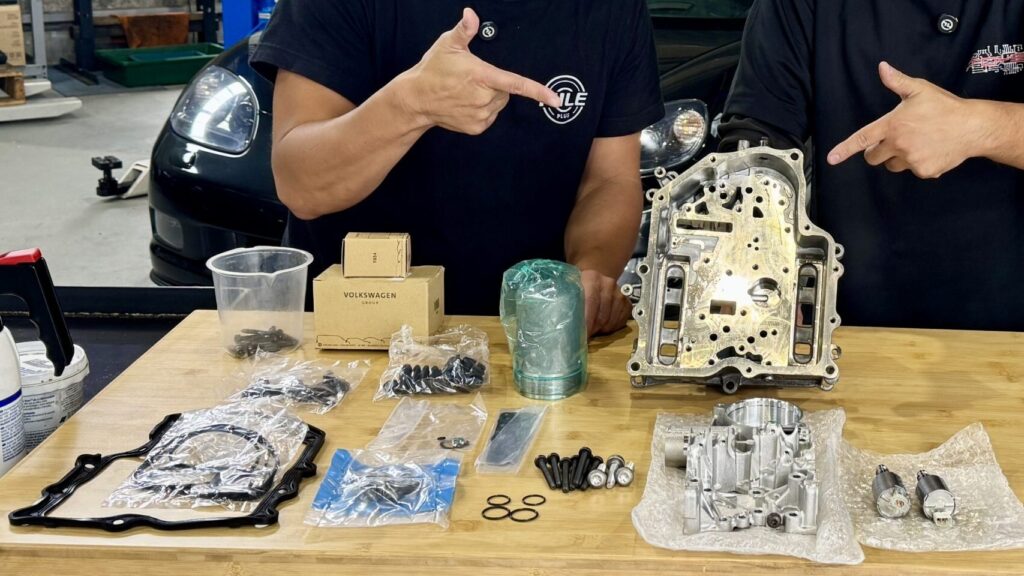
The mechatronics unit is the transmission’s control tower
, integrating electronic control (computer) and hydraulic control . It reads shifting and accelerator inputs, instantly determines which gear to select, and hydraulically moves the forks to change gears.
In other words, the mechatronics issues a “command” and the fork “actually moves.” When the car doesn’t move, as in this case, it means that
the command has been given but the fork doesn’t physically move .
🚨 Why are fork parts prone to problems?
Dry DSGs are designed to be lightweight, so the internal temperature rises easily,
which can lead to grease deterioration and insufficient lubrication.
Additionally, the rear side of the 6th gear is frequently used for parking and reversing, so
the load on the bearings is concentrated, causing gradual wear.
As a result, the fork becomes stuck and you
are unable to select a gear, resulting in a situation where the fork will not move even though it is in either D or R.
💬 Summary: Understanding the structure reveals the cause
The dry DSG (DQ200) is
a precise and lightweight design, but it is also very sensitive to heat and lubrication. This is why there are many cases of physical malfunctions
rather than “electronic control abnormalities.”
👉 Summary of drive and transmission problems | Repair costs and solutions for DSG, clutch, etc.
Click below to jump to articles about engine, drive, exhaust, and cooling system problems and repair costs.
You can scroll
In the next chapter,
we will finally explain in an easy-to-understand manner the mechanism behind the direct cause of this symptom: fork bearing sticking.
The core cause of the failure: Why does fork bearing “sticking” occur?
⚙️ What is a “fork” that moves the gear?
Inside the transmission
there is an arm-like part that switches gears; this is called a shift fork .
The fork receives hydraulic signals from the mechatronics unit and slides back and forth
to select and engage the corresponding gear.
Simply put, it is the part that physically determines “which gear you will be riding in . “
The problem occurred in the 6th gear/R fork.
In the 7-speed dry DSG (DQ200), only the part
of this fork that handles 6th gear and R (reverse) has a special structure.
While a normal fork is supported by a sleeve (a cylindrical bearing),
this part has a small bearing built in to reduce rotational resistance .
However, this is where problems can occur.
Cause 1: Bearing grease deterioration and wear
The lubricating grease inside the bearings
gradually dries out over time and heat, causing its lubricating performance to decrease.
Since dry DSGs do not cool the clutch with oil,
the temperature inside the transmission tends to rise,
which causes the grease to deteriorate quickly .
As a result, the bearings become stiff and
the fork will not move in the direction you want it to.
⚠️ Cause 2: “Biting” due to thermal deformation
Heat also affects the dimensions of metal parts:
the bearing circumference and sleeve expand,
distorting the moving parts of the fork by microns ,
causing the bearing to jam inside the sleeve.
Once it gets stuck, the fork will not move no matter how much hydraulic pressure the mechatronics apply, and
the gear cannot be selected, resulting in a situation where “it can be put into both D and R but will not move.”
🧠 Cause 3: Long-term wear and metal powder accumulation
Inside the DSG, fine metal powder is generated due to wear of the clutch and gears.
Normally, this would be washed away by oil, but with a dry structure, the amount of circulation is low, so
metal powder tends to remain in the fork area.
This metal powder gets into the gaps between the bearings and sleeves,
gradually impeding their movement –
eventually, as the wear progresses, they become completely stuck and no longer move.
🔄 Physical lock, not electronic control
This fork sticking problem is not an electronic failure but a purely mechanical locking phenomenon .
In other words, even if the mechatronics unit is issuing commands correctly,
the part that receives the commands (the fork) will not physically move, so
the entire system will be in a state where “commands are being issued but the gears will not shift.”
🧩 Why do they sometimes return temporarily?
If the forks are not completely fixed, they may temporarily come loose
due to restarting or vibrations . As a result, you may feel like the next day it’s working or you can ride again, but because the underlying wear and thermal deformation remains, it will only be a matter of time before the problem reoccurs.
🚨 Conclusion: Here is the core of the DSG problem
Most of the problems with the DQ200 not working are caused by the bearing getting stuck in
the 6th gear/R fork .
This mechanical part reaches its limits before the electronic control or clutch,
causing symptoms similar to a broken transmission.
Improvements with countermeasure parts: Why durability improved by replacing bearings with sleeves
The manufacturer quickly identified the cause of the “not working” problem with the 7-speed dry DSG (DQ200), and
later models have already evolved to include improved parts structures
. Here we will briefly explain how the structure has changed.
🔍 Before improvement: Weakness of fork structure with bearings
The early DQ200 had a small bearing built
into the fork in charge of the 6-speed R range . This bearing was designed to make rotation smoother, and at first glance it appears to be a highly precise structure.
However, in reality, this part had a weakness: it was susceptible to heat and wear
. Over time, the internal grease deteriorated,
causing the bearing balls to become jammed inside the sleeve.
As a result, the fork movement became stiff, and
no matter how much hydraulic pressure the mechatronics sent, the gears would not engage.
🔧 After improvement: The bearing has been eliminated and replaced with an integrated sleeve structure.
To solve this problem from the root,
the later model eliminated the bearing structure and changed to a sleeve-integrated type (linear slide structure).
In other words, the number of “rotating parts” was reduced, and a simple structure was created where the
mechanism moves by sliding .
This makes the inside less susceptible to wear particles and thermal deformation,
making it less likely to jam like before.
The sleeve material has also been improved, greatly improving both durability and thermal stability.
⚙️ Improvement effect: The risk of recurrence is significantly reduced
Units that use this improved sleeve
have seen a significant reduction in problems such as “not working” and “gears not engaging.”
In fact, the number of reports of inability to drive has visibly decreased since the later models.
However, replacing it with this replacement part requires
removing and disassembling the transmission
. Although the labor cost is high because it involves removing the clutch unit,
replacing the entire structure makes it possible to fundamentally prevent the problem from recurring.
🧩 Repair options: Rebuilt transmissions are also effective
When repairing, we also recommend replacing it with a rebuilt transmission
that has been designed to address the issue. Not only is it less expensive than a new one, but
most rebuilt parts come with a warranty of around six months to one year.
This is the perfect option for those who don’t want to experience the same breakdown again.
Looking at it this way, we can see that the DQ200 is not just a “transmission that breaks easily,” but is
a mature transmission that has undergone many improvements
. If you understand its structure and maintain it properly,
it will have evolved into a transmission that you can use with peace of mind for a long time.
Even repair shops that usually focus on Japanese cars will be able to accept more European cars if they understand the procedures and precautions for servicing
them. If you’re preparing your shop to handle imported cars, check out Yolost, which offers a wide range of maintenance supplies and work environment items
. They stock items that are useful for any manufacturer’s vehicle, including wiring, batteries, and engine oil.
Many of their products are easy to use even for beginners, making them a great first step in DIY maintenance .
- Won’t move in D range? Causes of 7-speed dry DSG malfunction and correct stopping operation
- Dry 7-speed DSG clutch structure and causes of judder | Generation differences, replacement methods, and tips for long life
- Is the judder in a 7-speed dry DSG caused only by the clutch? Reasons and solutions for improving it with ignition system maintenance
- Causes and repairs for DSG mechatronic oil leaks | Tips for replacing gaskets and O-rings for 7-speed dry DSG
Common mistakes: Do “habits” when parking lead to breakdowns? The mechanism
| NG operation | explanation |
|---|---|
| On a slope, put the parking brake in first, then apply the handbrake. | Load remains in the drive system, and force is applied to the gear position fork. |
| Quickly switch from R to D just before stopping | Shock is applied to the clutch and gear, damaging the sliding parts of the fork. |
| Pressing the shift key repeatedly while the vehicle is stopped (N⇄D, etc.) | Mechatronics repeats unnecessary hydraulic operations |
You can scroll
Fork problems with the 7-speed dry DSG (DQ200) can occur
not only due to structural weaknesses, but also due to minor operational mistakes when stopping the bike
. Sometimes, actions that you do every day without thinking about them can actually be putting strain on the internal parts.
🚫 Wrong Operation ①: Shifting into P range first on a slope, then applying the handbrake
When stopping on a slope, many people tend to put the car in P and then pull the side of the car to make sure it is safe.
However, with a dry DSG, this puts a lot of stress on the drivetrain .
When you shift into P range, a “parking pole” inside the transmission locks the gear in place.
If there is still weight on the vehicle body in that state,
a large force is applied to the fork, clutch, and parking pole,
causing unnecessary twisting of the tiny bearings and sleeves inside.
In particular, the 6-speed/R shift fork is structurally delicate, so
it becomes stiff with repeated shifting,
which ultimately causes the shift to jam and become stuck the next time it is shifted.
⚠️ Wrong Operation ②: Quickly switching from R to D just before stopping
Be careful not to shift from R to D before coming to a complete stop, such as when backing up.
If you select a gear in the opposite direction while the clutch is still rotating,
a shock will be sent to the meshing of the fork and gear.
This can lead to minute deformation of the bearings and hydraulic shock to the solenoid valve.
⚙️ Wrong Operation ③: Pressing N⇄D repeatedly or shifting gears frequently while the vehicle is stopped
When waiting at a traffic light, for example, “put it in N and take a break” or “when the light turns green, put it in D” and
then frequently change gears in a short period of time can actually cause strain.
Because the dry DSG uses hydraulic pressure to move the forks,
repeated unnecessary operations can cause stress to build up in the hydraulic lines,
shortening the life of the solenoid .
The accumulation of these operations
ultimately makes the fork bearings more susceptible to seizure.
In other words, the lifespan of a DSG is determined not by how you ride, but by how you stop.
If a load is applied to a bearing that is slightly engaged,the metal will expand and hydraulic stress will cause it to stick, resulting in the problem of being unable to shift into either D or R when restarting.
Proper stopping procedure – “Stopping habits” that will extend the life of your DSG
The 7-speed dry DSG (DQ200) is a transmission where how you stop is even more important than how you ride.
The internal gears and forks are precisely meshed, so
if you get the operating procedure wrong when stopping, stress will accumulate in unseen places.
Conversely, if you learn the correct procedure,
you can significantly extend the life of the forks and clutch.
✅ Step 1: First, step on the brakes and come to a complete stop
The first rule is to always come to a complete stop with your foot on the brake .
If you shift gears before the bike has come to a complete stop,
the fork inside will move while the clutch and gears are still rotating.
This momentary shock can cause bearings to stick or sleeves to wear out.
✅ Step 2: Firmly apply the parking brake
The next thing to do is to apply the handbrake before shifting into P range .
If your car has an electric parking brake, activate it before pressing the P button.
This will shift the weight of the car body to the handbrake, and
no excess force will be left in the drivetrain.
If you are stopped on a slope,
keep your foot on the brake and make sure the vehicle has come to a complete stop before pulling the side.
✅ Step 3: Shift into P range after the vehicle has stopped
After applying the side gear, wait until the car has completely stopped shaking before shifting into P. By
simply observing this timing, you can reduce the load on the P pole and gears to almost zero.
The ideal order is “stop → lock → shift into P.”
✅ Step 4: Finally, turn off the engine
Once the vehicle is in P range and has completely stabilized, turn off the engine.
At this point, the internal oil pressure will naturally release and the mechatronics will return to a static state.
As a result, gear jamming will be less likely to occur the next time you start the vehicle.
Just by following this procedure every time,
the life of the fork and sleeve will be extended remarkably.
In particular, since the hydraulic pressure of a dry DSG is delicate,
“side shift before P” – this simple step makes a big difference.
Risk of neglect: The process by which a minor malfunction turns into a major breakdown
“It stopped working once, but it was running fine the next day.”
Even in such cases, it is extremely dangerous to leave it as it is.
A stuck fork bearing is
not just a “one-off malfunction,” but a progressive problem that will recur repeatedly .
🔸 Early stage: Fork movement becomes sluggish
At first, you may feel a slight “stickiness” when starting the engine or switching from R to D.
When you shift, there may be a momentary delay before the clutch engages, and
you may feel a very slight shift shock.
In most cases , if you change the oil and check the lubrication of the fork at this stage, it will be possible to prevent a recurrence.
In other words, if you act quickly, it is still not too late.
🔸 Mid-stage: Bearing sticking → Fork malfunction
If left unattended, the grease inside the bearing will dry out completely, and
the metal powder will become interlocked, causing the fork to become completely stuck .
In this state, the gear will not move even when hydraulic pressure is applied, and
the mechatronics will record an error message saying “commands are being issued but there is no response.”
At this stage, you will not be able to select a gear even when you shift, and
the symptom of “it goes into both D and R but doesn’t move” will occur all the time. This
cannot be solved by simple cleaning and will require disassembly and repair .
🔸 Severe: Secondary damage to surrounding parts
If you repeatedly try to drive or restart the bike with a stuck fork,
the hydraulic lines will become overloaded, affecting the mechatronics and solenoid valves
. In the worst case scenario, the electric pump in the mechatronics will overheat and stop hydraulic pressure from being pumped in.
This can even damage the clutch, resulting in expensive repairs (300,000 to 500,000 yen) .
🚨 Early inspection means the biggest savings
The smartest way to deal with fork trouble is not to wait until it stops working, but
to have it inspected as soon as you start to wonder if something is wrong
. If you do it early, you won’t have to remove or disassemble it, and the cost will be in the tens of thousands of yen range.
On the other hand, the longer you leave it thinking, “It’s working again, so it’s fine,” the more
the damage will spread and the larger the scope of the repairs will become – that’s the scary thing about this type of trouble.
Estimated repair and replacement costs: How much will it cost to fix it? (Parts, labor, and replacement products)
If you experience the symptom of “it can be put into both D and R but won’t move,”
unless it’s a simple sensor error, the inside of the transmission will need to be disassembled and repaired.
This is not cheap,
however, and the cost varies widely depending on the part that is causing the problem and the repair method.
Below are some general guidelines for Volkswagen specialist workshops.
| Work content | Cost (tax included) | Contents/Notes |
|---|---|---|
| DSG transmission removal and disassembly | Approximately 100,000 to 150,000 yen | Includes clutch unit removal and internal inspection |
| Fork bearing sleeve replacement (measures) | Approximately 150,000 to 250,000 yen | Replacement with abolished bearing sleeve/Parts included |
| Mechatronics unit replacement | Approximately 200,000 to 300,000 yen | Includes electric pump and solenoid / needs to be reprogrammed |
| Rebuilt transmission replacement | Approximately 350,000 to 500,000 yen | Guaranteed full replacement with refurbished product/Most reliable |
| Oil change and degreasing cleaning only | Approximately 15,000 to 25,000 yen | Response to minor symptoms and regular maintenance |
You can scroll
You can jump to an article that explains the costs and effects of each.
You can scroll
👉 Summary of maintenance and customization costs and work days at VW specialty store Nile Plus
💡 Which is better: part repair or rebuild replacement?
- Partial repair (replacement of fork)
- Effective when the cause is clear and the clutch and mechatronics are normal.
The risk of recurrence is low, but it takes time (approximately 3 to 5 days) due to the large amount of work required for removal and disassembly. - Rebuilt replacement
→ Replace the entire transmission with a new one with a countermeasure structure. This method
often comes with a warranty (6 months to 1 year), so if you are considering long-term use, this is the safest option.
It costs money, but the risk of recurrence is almost zero.
🧾 Points to consider when considering repairs
- If the mileage is less than 50,000km , just replacing the forks will suffice.
- If it has occurred more than 80,000 km or multiple times , consider replacing it with a rebuilt part.
- If it is within the dealer’s warranty period , it may be covered by the warranty, so be sure to check.
Volkswagen’s DSG parts are made with extremely high precision, and
if repaired correctly once, the recurrence rate tends to be low.
However, there are some vehicles that repeatedly experience the same problems, and
the deciding factor in maintenance is “when to change to a fixed part.”[DSG] The wrench symbol is on! The car won’t move even when you put it in gear! A VW specialist explains the second most common problem with 7-speed dry DSGs! [Secret troubleshooting tips included]
Frequently Asked Questions (FAQ)
Q1. If the car doesn’t work even in D range, should I immediately assume it’s broken?
No, it doesn’t necessarily mean that the entire transmission is broken.
In most cases, the 6th gear/R side fork bearing is just temporarily jammed.
In this state, the gears are physically unable to move, and as a result, it appears that the bike cannot be ridden.
If it is only a temporary jam, it may be possible to release it by waiting a while or by performing emergency repairs.
However, if it happens repeatedly, the fork will need to be replaced or rebuilt.
Q2. The dealer said it was a “mechatronics problem,” but is that not true?
When a warning light comes on or the vehicle becomes unable to drive, dealers
tend to first suspect a faulty mechatronics (hydraulic control unit).
However, in many cases, this symptom is caused by a mechanical fork sticking, not electronic control.
If no error codes remain during the diagnosis,
it is recommended to have the fork inspected rather than having the mechatronics replaced.
Q3. What can I do to prevent recurrence?
The most important thing is how you operate the bike when stopped .
Avoid actions like “putting it into P first” or “switching from R to D immediately” when going up a slope, and
get used to using the correct sequence (brake → side → P)
. This will significantly reduce the torsional stress on the fork and bearings.
Regularly changing the oil (gear lubricant) is also effective.
Q4. How much does the repair cost?
Repairing only the fork section will cost around 150,000 to 250,000 yen,
while replacing the transmission with a rebuilt one will cost around 350,000 to 500,000 yen.
While this may seem expensive at first glance, if a fundamental repair is performed, the risk of recurrence is extremely low, and
in the long run it will also be a “preventive investment” to protect the mechatronics and clutch.
👉 Summary of maintenance and customization costs and work days at VW specialty store Nile Plus
Q5. What is a rebuilt product?
A rebuilt transmission is a recycled product in which a used transmission is disassembled, cleaned, and
all worn parts replaced with new or modified parts. It is
cheaper than a new one, and because the structure has been updated to the latest model (bearingless specification),
it is very effective in preventing recurrence.
Many VW specialty stores offer it with a 6-month to 1-year warranty.
Q6. Once these symptoms appear, is it inevitable that they will recur?
No.
By replacing the parts with the correct ones and following the correct operation, it is possible to prevent the problem from recurring .
In particular, durability has been greatly improved since the change to the later model sleeve structure, and
it is extremely rare for the same symptoms to occur on vehicles that have been properly repaired.
We also recommend these articles:
- Volkswagen Abnormal Noise Diagnostic Guide | Causes, Repair Costs, and Urgency
- Summary of causes of poor running performance | Check points when your car won’t move forward, is unstable, or vibrates
- A comprehensive guide to VW suspension problems, repairs, and maintenance | Basics of bushings, suspension, bearings, and alignment, and symptom-specific checks
▼List of individual articles on DSG repair and maintenance▼
You can scroll
Details of defects by vehicle type
Even if the “way” of the malfunction is similar, “which model has the most common problems” differs slightly depending on the model.
The following page summarizes the trends by model and common malfunction cases among other owners.
This is a guide to keeping your DSG (dual clutch) in good condition for as long as possible.
First, understand how it works, then check out preventative maintenance, then repair options and costs.



コメント