



When you pass a step, you feel that the steering wheel is taken or the car is swung from side to side, you will be anxious.
In VW, there are several typical causes due to the structure of the undercarriage, and if left unattended, it can lead to uneven tire wear and wobbly while driving.
In this article, we organize the causes that should be suspected when the steering wheel is taken over a step in an easy-to-understand manner by structure, and even summarize simple DIY checks and repair costs.
First of all, let’s correctly grasp the trend of symptoms for safety.
▼Driving problem diagnosis guide▼
👉Comprehensive summary of causes of poor runningry of causes of poor running




Common symptoms
- When passing a step, the steering wheel is taken to the left and right
- The car wobbles for a moment / Poor straightness
- The lower the step, the easier the steering wheel is to shake.
- Symptoms may intensify on rainy days or ruts
- Tire replacement does not improve
There are three main causes (suspension, steering system, alignment)
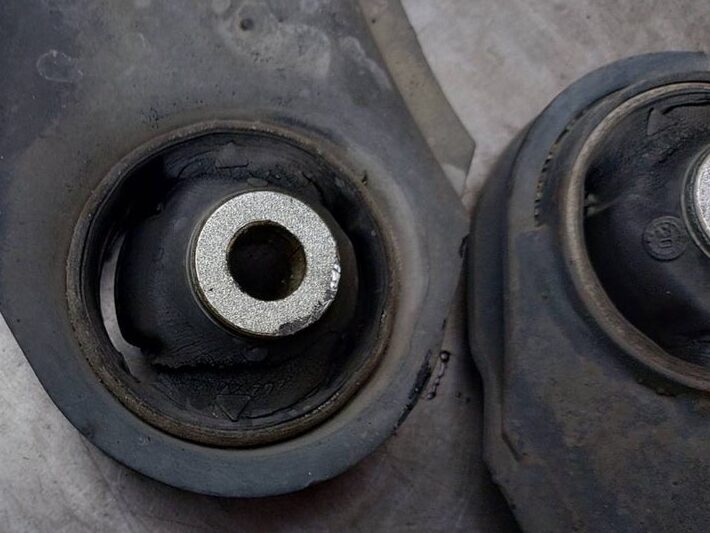
Cause (1) Undercarriage rattling (lower arm, ball joint, bushing)
When does it happen?
The steering wheel is taken the moment when the upper and lower inputs such as steps and ruts are entered.
Noticeable at low to medium speeds.
Why does it happen? (Structure)
The VW undercarriage supports the body and hub with the lower arm, but when the bushing or ball joint deteriorates, the fixing force weakens, and the hub shakes left and right on the step → which is transmitted to the steering wheel and the steering wheel is taken.
If left unattended?
- Straight is not stable
- The car flows when braking
- Tires wear unevenly
Level 2: Can drive but is prone to deterioration
Cause (2) Steering system rattling (tie rod end, rack bushing)
When does it happen? The moment you pass through
a step or seam, there is a “thud” and the position of the steering wheel is slightly off.
Structural reasons
The tie rod end is an important part that transmits movement from the steering rack to the tires.
When this is worn, each impact input causes a slight delay or play, and the steering wheel is taken away for a moment.
If left unattended?
- Steering becomes less responsive
- There is a delay at the beginning of the turn
- At worst, the rattle progresses and the driving becomes unstable
Level 3: If the rattle is large, driving is not allowed
Cause (3) Poor alignment (after suspension replacement, curb hit)
When does it happen? Even though I am running
straight, I lean to either the left or right. If you are shaken on a
step, the steering wheel will be taken away.
Structural reasons
When the toe angle and camber are misaligned, the resistance of the left and right tires changes, and a temporary difference in force occurs on the step, which affects the steering wheel.
If left unattended?
- Tire fragmentation
- Worse fuel economy
- Reduced straight-line stability
Levels 1 to 2 (depending on the state)
Points that can be checked in DIY
- When you stop the car and shake the steering wheel lightly from side to side, is there a “clattering” reaction?
- Shake the tires with your hands and see if there is any play up and down, left and right.
- Can you slowly pass through steps and reproduce the sound and shaking of the steering wheel?
- Have you been on the curb lately?
- Can you visually see tears in the suspension and bushings
Only to the extent that it can be done safely/The final decision is made at the maintenance shop.
Is it okay to drive? (Urgency)
- Level 1: Can be driven for a while, only slight misalignment.
- Level 2: Risk of worsening symptoms Cracks
in the lower arm bushings and slight rattling of the ball joints. - Level 3: Driving NG (towing recommended)
Large rattle at the end of the tie rod and reduced steering responsiveness.
When a driving problem occurs, it may be necessary to tow the truck depending on the situation.
In these cases, it may be covered by road assistance or riders of automobile insurance, so it is safe to lightly review the contents of your current contract.
If you may not have a proper understanding of the coverage, you can use a comparison service to check the coverage details and premiums of multiple companies at once. Since you can get a complete picture in a short time, many people use it for repairs and inspections.
👉 Free Car Insurance Bulk Quote Service
Approximate repair cost
| Work Description | Approximate cost |
|---|---|
| Lower Arm Bushing Replacement | 20,000 to 45,000 yen |
| Tie Rod End Replacement | 15,000 to 30,000 yen |
| Ball joint replacement | 15,000 to 35,000 yen |
| Alignment Adjustment | 10,000 to 18,000 yen |
| Diagnosis fee | 5,000 to 10,000 yen |
You can scroll
It is better to inspect before the condition deteriorates, and as a result, the cost will be cheaper.
👉Summary of maintenance and custom costs & working days of VW specialty store Nile Plus
Related parts to check at the same time
- Suspension (damper leakage, oil leakage)
- Stabilize Link
- Hub Bearings
- Drive shaft (boot tear, rattle)
- Tire wear condition
- Upper Mount
▼List of individual pages about undercarriage repair and maintenance▼
Conclusion
If the steering wheel is taken over a step, the main cause is a rattle of the undercarriage and steering, poor alignment.
It is difficult to tell from the outside, and as it progresses, it leads to deterioration of straightness and uneven wear.
Be especially careful as the steering system rattle is related to driving.
If you have any symptoms that bother you, it is safe to have them checked as soon as possible.
Even if the symptoms are similar, the causes vary from vehicle to vehicle.
Even if there are similar abnormal noises and malfunctions, there are various causes such as turbo belts and sensors.
If you are unsure, it is safe to have it inspected at a maintenance shop without overdoing it.
What to read next
Please proceed to the article below that best describes your symptoms.
- Steering Wheel Jerks on Bumps? How to Diagnose Undercarriage Rattles and Play
- Steering Wheel Flutter at High Speed: Causes and Loss of Straight-Line Stability
- Steering Wheel Pulls to One Side: Alignment vs Tire Issues and How to Tell
- Car Pulled by Road Surface Bumps? Causes of Tramlining in VW and How to Fix It
- Why Won’t My Car Drive Straight and Why Is It Making Noise? Common Causes Explained
- Causes of increased steering play|If you feel “rattling” on the steering wheel
- Why Doesn’t My Car Track Straight After New Tires? Alignment and Setup Issues Explained
- Car Won’t Track Straight? Symptoms of Worn Undercarriage Bushings and How to Tell
- Why Doesn’t EPS Correct Steering? Straight-Line Instability in VW Without a Warning Light
- Car Feels Floaty or Unstable? Causes of Suspension Failure and Shock Wear Symptoms
Defect details by vehicle type
Although the “way of getting out” the defect is similar, “which model has many problems” is slightly different for each car model.
Trends by vehicle model and common breakdown cases among other owners are summarized on the following page.
Frequently Asked Questions (FAQs)
Q1. Is it dangerous to have the steering wheel taken on a step?
A1. If the cause is a rattling of the undercarriage or steering, you need to be careful as it can lead to reduced straightness and uneven tire wear. In particular, the steering system rattle is related to driving, so it is recommended to check it as soon as possible.
Q2. Why doesn’t it improve even if I change the tires?
A2. If the cause is in undercarriage parts such as lower arm bushings and ball joints, the symptoms will not change even if the tires are new. This is because the root cause is the deterioration of structural fixation.
Q3. Are there any points that can be judged by DIY?
A3. It is effective as a simple check to see if there is a “rattling” reaction by gently shaking the steering wheel, or if there is any play on the tires. However, for safety reasons, it is certain to leave the final decision to the maintenance shop.
Q4. Can the handle be removed just by poor alignment?
A4. Yes. If the toe angle or camber is misaligned, the left and right resistance may change, and the force may be unbalanced at the step input and the steering wheel may be shaken. Particular care should be taken after hitting the curb or after undercarriage work.
Q5. Is it okay to run for the next few days?
A5. If there is a slight misalignment, it is possible to drive temporarily, but if you suspect a steering system rattle, you may not be able to drive. The degree of urgency varies depending on the severity of the symptoms, so it is safe to check as soon as possible.




コメント