


If the coolant warning light suddenly comes on while you’re driving , you may be worried and wonder,
“Is it okay to keep driving like this?” or
“I heard that the engine could seize up, but is that true?”
Coolant is an essential liquid for stabilizing the engine temperature, and
if something goes wrong, it can cause serious damage to the engine.
In this article, we will explain
the meaning of the coolant warning light, which is common in VW vehicles, common causes, whether the vehicle is drivable, first aid, and an estimate of repair costs .
Not all Volkswagen warning lights mean immediate danger.
To decide what to do right now, check just these three points.
① Color
② How it lights up
③ When it appears
If your warning light comes on, read this article first
👉 VW Warning Lights Guide
- 🛠 Engine, exhaust and cooling system warning lights
- Engine check light
- EPC warning light
- DPF warning light
- AdBlue warning light
- Coolant warning light
- 🛡 Brake, safety, and driver assistance warning lights
- ABS warning light
- ESP/ESC warning light
- Parking brake/EPB warning light
- Airbag warning light
- ACC, Lane Assist, Front Assist warning lights
- Tire Pressure Warning Light (TPMS)
- 🔌Electrical and drive system warning lights
- Battery warning light
- Oil pressure warning light
- Steering/power steering warning light
- Gearbox (DSG) warning light
- What the coolant warning light means (color, lighting/flashing, what it indicates)
- Three things to check first (color/lighting pattern/symptoms)
- Common causes of coolant warning light (organized for VW)
- Can I drive when the coolant warning light is on?
- First aid and what not to do
- Estimated repair costs (general example for VW)
- What happens if you leave it alone?
- Information you should organize before consulting a specialist factory
- FAQ
- Details of defects by vehicle type


What the coolant warning light means (color, lighting/flashing, what it indicates)
The VW coolant warning light is a lamp that indicates
abnormalities in the coolant level, temperature, and cooling system .
yellow light on
- Low coolant level
- Needs refilling
Red light
- Engine temperature is too high
- Serious cooling system abnormality
- Imminent or in the process of overheating
It will be easier to make a decision if you remember that yellow means “caution” and red means “emergency stop level.”
Three things to check first (color/lighting pattern/symptoms)
① Lamp color (yellow or red)
- Yellow: Possible low coolant
- Red: Risk of overheating → Stop immediately
② Engine condition
- Is the water temperature gauge rising?
- Is the fan making a loud noise?
- Is there any steam coming out of the hood?
③ Air conditioner status
If it is close to overheating, it may suddenly stop cooling .
Common causes of coolant warning light (organized for VW)
① Natural decrease and evaporation of cooling water
If it has not been refilled for a long time, or if it deteriorates over time, it may gradually decrease.
② Deterioration of the water pump
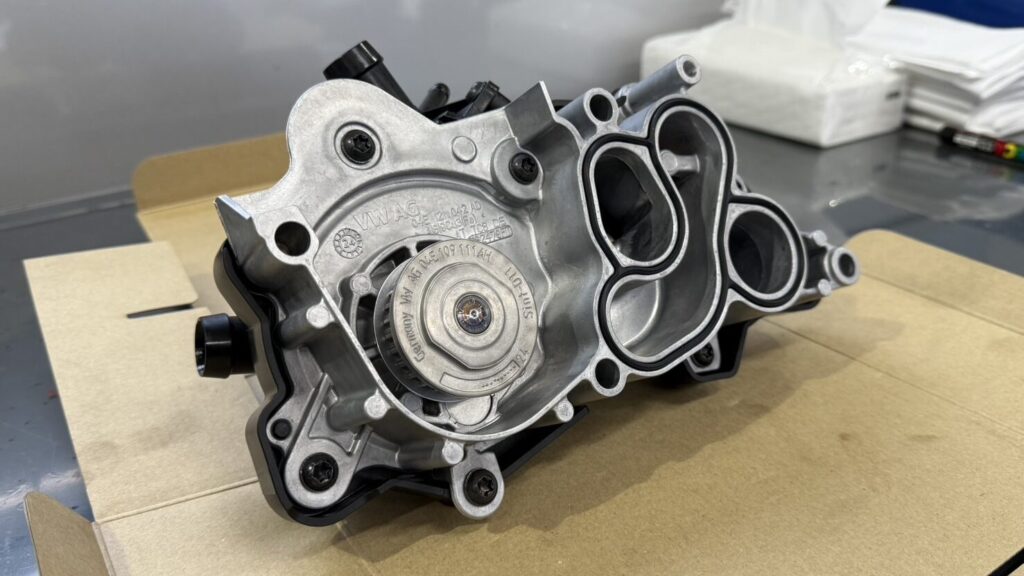
Impeller wear and internal leaks can reduce cooling capacity,
leading to warning lights and rising water temperatures.
Cost and effectiveness of water pump replacement
3) Stuck thermostat
The coolant cannot circulate according to the temperature,
resulting in symptoms such as not being able to cool or heat building up.
👉 VW Thermostat Malfunction and Estimated Repair Cost
④ Radiator hose leak
Coolant may leak from cracks in the hoses or loose joints.
👉 VW Radiator Malfunction and Estimated Repair Cost
⑤ Faulty radiator cap
Pressure cannot be maintained and cooling performance will decrease.
⑥ False detection of the sensor
Failure of the level sensor that measures the amount of coolant is also common in VWs.
Can I drive when the coolant warning light is on?
Cases where it is okay to drive
- Yellow light (insufficient warning)
- There is no rise in water temperature and no loud abnormal noises in the engine.
- The cooling fan is working properly
In this case, it may just be that it’s “decreasing.”
Cases where driving is dangerous (red light)
- It’s lit red
- The temperature gauge is rising
- Steam from the hood
- Abnormal noise (rattling/rumbling)
- The air conditioner suddenly stops working
If it is red, there is a risk of overheating
, so you should not try to drive but should stop the engine and wait for it to cool down.
First aid and what not to do
first aid
*Please do this in a safe place
- Allow the engine to cool completely (at least 30 minutes)
- Check the coolant level in the reserve tank
- If it is not enough, add more (genuine G13 or water as a temporary measure).
- Please note that it will not recover immediately after replenishment.
What not to do
- Opening the cap when it is hot may
cause it to spray out and cause severe burns - Continuing to drive with the red light on
→ Head gasket damage and engine seizure - Continuing to add only water
→ Causes rust, corrosion, and reduced cooling capacity
If you use water as an emergency measure, be sure to replace it with genuine coolant once the situation has settled down .
Estimated repair costs (general example for VW)
| Fault location | Content | Estimated cost |
|---|---|---|
| Coolant refill | G13 replenishment | 2,000 to 4,000 yen |
| Hose/radiator leak | repair | 5,000 to 30,000 yen |
| Radiator replacement | Parts replacement | 40,000 to 100,000 yen |
| Water pump replacement | Parts replacement | 40,000 to 80,000 yen |
| Thermostat replacement | exchange | 20,000 to 50,000 yen |
| Sensor replacement | exchange | 5,000 to 15,000 yen |
You can scroll
* Varies depending on vehicle model and year.
👉 Summary of maintenance and customization costs and work days at VW specialty store Nile Plus
What happens if you leave it alone?
If the coolant warning light is left unattended, it can lead to serious risks such as:
- Overheating → engine seizure
- Damaged head gasket
- Expensive repairs (some cases costing over 200,000 to 500,000 yen)
- Expansion of the cooling system’s overall failure
Don’t let your guard down just because it’s yellow, and it’s important to take action early.
Information you should organize before consulting a specialist factory
- Is the warning yellow or red?
- Water temperature gauge status
- Replenishment History
- Presence or absence of leak marks
- Recent cooling fan noise
- Simultaneous warning lights
Communicating this will help the inspection go smoothly.
FAQ
Q1. Is it okay to ignore the yellow coolant warning light?
Even if there is only a small shortage, if left unattended it may repeatedly relight and in the worst case scenario lead to overheating, so it is best to check it early.
Q2. Can I refill the coolant myself?
Refilling itself is possible, but care must be taken as incorrect mixing ratios or types (G13) can lead to malfunctions.
Q3. Why does the warning not go away even after I refilled it?
A faulty level sensor or an abnormality in the entire cooling system is suspected.
Q4. Why does the air conditioner stop working when the water temperature is high?
This is because the air conditioning is limited to protect the compressor.
Q5. What should I do if steam comes out of the hood?
Immediately stop the vehicle, turn off the engine and wait for it to cool. Do not touch the cap.
Details of defects by vehicle type
Even if the “way” of the malfunction is similar, “which model has the most common problems” differs slightly depending on the model.
The following page summarizes the trends by model and common malfunction cases among other owners.



コメント