


“My car doesn’t seem to be driving straight today…”
This strange feeling starts with many people feeling it “vaguely.”
- The steering wheel shakes slightly left and right when driving straight
- Wobbling at high speeds
- It is easy to get caught in ruts on the road
- The car drifts sideways due to a step
These symptoms are caused by misalignments in multiple elements, such as the suspension, tires, steering system, suspension, and EPS (electric power steering)
. Warning lights often do not come on, and it is not uncommon for the problem to progress to uneven tire wear or loose suspension without you even noticing.
In this article, we’ve outlined the most common reasons why you might feel like your VW won’t run straight, and have compiled them so that you can easily move on to the individual article that best suits your symptoms.
▼Driving problem diagnosis guide▼
👉Comprehensive summary of causes of poor running



The first thing to suspect when your car doesn’t run straight
Poor straight-line stability can be broadly divided into the following categories:
① Misalignment
This is the most common cause.
Tire changes, curbing, bump impacts, and misalignment of the subframe can cause the front, rear, and left/right angles to become misaligned, preventing the car from running straight.
② Tire problems (uneven wear, air pressure, immediately after replacement)
If there is a difference in air pressure, uneven wear, or a difference in the wear pattern on the left and right sides, the car will not run straight. The
“chemical film” that forms after installing new tires or an assembly error can also cause discomfort.
3) Deterioration of suspension bush joints
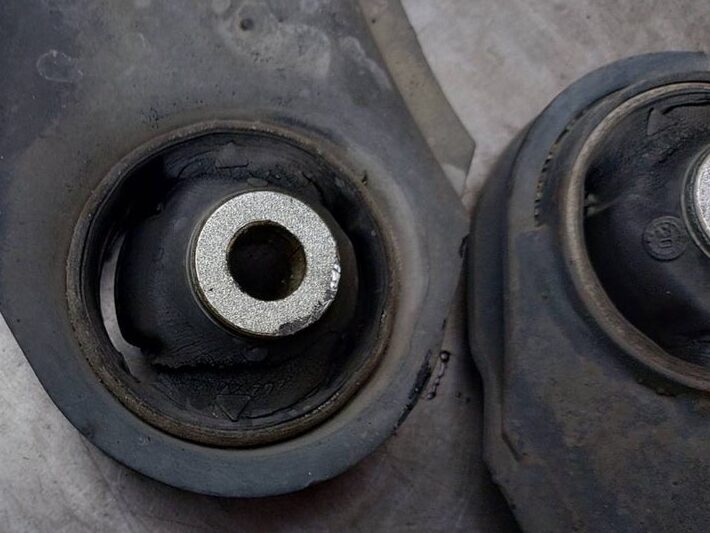
If there is looseness in the lower arm bushings or stabilizer links, symptoms such as the car being pulled over bumps or drifting when driving straight will occur.
Deterioration of the bushings directly affects straight-line stability.
Related:
Straight-line driving becomes unstable due to deterioration of suspension bushings | Symptoms and how to identify them |
Causes of steering wheel jerk on bumps | Tips for identifying looseness in the suspension
④ Suspension wear (shock weakening)
If the shock absorbers are not working properly, the car may feel like it is “sliding” sideways and swaying up and down,
especially at higher speeds.
Related: Causes of a car drifting due to suspension wear | Signs of shock deterioration
⑤ EPS (electric power steering) correction is not working
VW’s EPS makes minute corrections when driving straight.
When this movement weakens, it can be felt as a slight “wobble” or “stability of the steering wheel.”
It is also notable that there are many minor defects that do not turn on the warning light.
⑥ Influence of road surface (ruts and tracks)
The feeling of being trapped in ruts can be made worse by factors related to the vehicle.
If you are experiencing more ruts than usual, you need to check the vehicle.
Related: Causes and solutions for getting stuck in road ruts | Why your VW is moving in the wrong direction
⑦ If there is an abnormal noise
Wobbling and strange noises are likely caused by a combination of factors, such as looseness in the suspension, broken hub bearings, or damaged bumper rubber.
8. If there is increased play in the steering system
As the play increases, the straight line becomes less stable and the bike becomes more prone to wobbling.
Related: Causes of increased steering play | If you feel a rattle in the steering wheel
Whether driving is possible and risks
Even if the symptom of not being able to drive straight is mild, it directly affects driving safety .
- Dangerous at high speeds
- Accelerates uneven tire wear
- Increased strain on the legs
- Accelerates bush deterioration
- EPS abnormalities are overlooked
It is especially dangerous on expressways when the road is moving without your hand to stop it . We recommend having it inspected early.
Checkpoints you can check yourself
Here are some things you can try right away.
●Tire pressure
If there is a difference between the left and right sides, the car can easily be stolen.
● Tire wear pattern
Outer/inner wear and stepped wear directly affect straight-line running.
●Tightening wheel nuts
Be sure to check it immediately after changing tires.
●Suspension sinking
Be careful if you can see a difference in vehicle height between the left and right sides.
Estimated repair costs
- Alignment adjustment : 12,000 to 22,000 yen
- Lower arm bush replacement : 20,000 to 60,000 yen
- Shock replacement : 40,000 to 100,000 yen
- EPS inspection/minor repair : from several tens of thousands of yen
Costs vary greatly depending on the cause of the condition.
👉 Summary of maintenance and customization costs and work days at VW specialty store Nile Plus
▼List of individual pages about suspension repair and maintenance▼
What to read next
Please proceed to the article below that best describes your symptoms.
- Steering Wheel Jerks on Bumps? How to Diagnose Undercarriage Rattles and Play
- Steering Wheel Flutter at High Speed: Causes and Loss of Straight-Line Stability
- Steering Wheel Pulls to One Side: Alignment vs Tire Issues and How to Tell
- Car Pulled by Road Surface Bumps? Causes of Tramlining in VW and How to Fix It
- Why Won’t My Car Drive Straight and Why Is It Making Noise? Common Causes Explained
- Causes of increased steering play|If you feel “rattling” on the steering wheel
- Why Doesn’t My Car Track Straight After New Tires? Alignment and Setup Issues Explained
- Car Won’t Track Straight? Symptoms of Worn Undercarriage Bushings and How to Tell
- Why Doesn’t EPS Correct Steering? Straight-Line Instability in VW Without a Warning Light
- Car Feels Floaty or Unstable? Causes of Suspension Failure and Shock Wear Symptoms
Details of defects by vehicle type
Even if the “way” of the malfunction is similar, “which model has the most common problems” differs slightly depending on the model.
The following page summarizes the trends by model and common malfunction cases among other owners.
Frequently Asked Questions (FAQ)
Q1. Is the steering being pulled due to the alignment? Or the tires?
Both are possible.
The first thing to check is tire-related issues such as air pressure and uneven wear, but if there are no abnormalities, it is most likely due to misalignment. It is best to check both together.
Q2. Is it dangerous if the vehicle only sways at high speeds?
Yes, it is.
There may be hidden problems that become apparent at higher speeds, such as weakened shock absorbers, reduced EPS compensation, or poor alignment.
Q3. After changing tires, my car no longer drives straight. Is this common?
It’s relatively common.
Straight-line running can be affected by the film on new tires, slight unevenness during assembly, or differences in air pressure. If the problem persists even after breaking in the tires for several dozen kilometers, an inspection is required.
Q4. My car won’t run straight, but why doesn’t the warning light come on?
This is because poor straight-line stability often causes the warning light to go off.
Minor EPS problems, worn bushings, misalignment, etc. are not reflected in the warning light.
Q5. When should you take your car to a workshop?
If you experience any of the following, we recommend an early inspection.
・The car slides when you need to hold it down with your hand at high speeds
. ・The car slides sideways over bumps.
・The tires are wearing unevenly.
・Your car feels strange even after using new tires or having the suspension serviced.
If necessary, you can rewrite the question set to be more in-depth.

