
Before reading this content, it will be helpful to check the basic knowledge of DSG to deepen your understanding.
👉 DSG Transmission Basics
If the gearbox warning light suddenly comes on while driving,
you may be worried
about “Is this the reason for the shift shock?” or
“What should I do if it stops moving…”.
Most VWs are equipped with DSG (dual clutch transmission), which
has a “higher ratio of electronic control” than regular ATs, so
it is easy to turn on the warning light when there is an abnormality.
In this article,
we summarize the meaning of DSG warning lights, when they are okay to drive/when they are not, causes, repair costs, and neglect risks in an
easy-to-understand manner.
Not all Volkswagen warning lights mean immediate danger.
To decide what to do right now, check just these three points.
① Color
② How it lights up
③ When it appears
If your warning light comes on, read this article first
👉 VW Warning Lights Guide
- 🛠 Engine, exhaust and cooling system warning lights
- Engine check light
- EPC warning light
- DPF warning light
- AdBlue warning light
- Coolant warning light
- 🛡 Brake, safety, and driver assistance warning lights
- ABS warning light
- ESP/ESC warning light
- Parking brake/EPB warning light
- Airbag warning light
- ACC, Lane Assist, Front Assist warning lights
- Tire Pressure Warning Light (TPMS)
- 🔌Electrical and drive system warning lights
- Battery warning light
- Oil pressure warning light
- Steering/power steering warning light
- Gearbox (DSG) warning light
- Meaning of DSG warning light (color, on/flashing)
- 3 points to check first (symptoms, situation, concomitants)
- Main causes of gearbox (DSG) warning lights
- Driving when DSG warning light is on
- Correct countermeasures (situational)
- Approximate repair cost (general example at VW)
- What happens if left unattended?
- Good information to prepare before consulting the factory
- FAQ
- Defect details by vehicle type
Meaning of DSG warning light (color, on/flashing)
The gearbox warning light displayed on VW changes its urgency depending on
the color and lighting pattern.
Yellow light
Mild abnormalities.
You can drive, but you may feel uncomfortable shifting.
例:Yellow light
Mild abnormalities.
You can drive, but you may feel uncomfortable shifting.
Example:
- Stagging at the start
- Shock in 2nd →3rd gear
- It takes time to get into D
Red Lighting
Serious mission anomalies.
Symptoms such as not being able to enter the gear, not being able to drive, and not being able to shift gears may occur.
Flashing
Increased urgency due to electronic control (mechatronics)-related errors.
This can lead to inability to shift, protection mode, etc.
3 points to check first (symptoms, situation, concomitants)
(1) Can you put the gear in? Will it move?
- “It goes into R, but not D.”
- “I enter D, but the creep is weak.”
- “Suddenly becoming neutral”
This information will be important in the diagnosis.
(2) When it is litis lit
- At low speeds in traffic jams
- Starting on a hill
- High temperature and long distance driving
- Rainy days (electrical system malfunction due to moisture)
DSG is characterized by a condition that makes it easy to develop symptoms.
(3) Simultaneous lighting of other warning lights
- EPC
- ABS
- Since they work together with the stability control
systems, there is a possibility that the concurrent will be electrical.
Related articles:DSG/Transmission
- Explained: The 6-Speed Wet DSG (DQ250)
- Won’t Move in D Range: Causes of 7-Speed Dry DSG (DQ200) Failure and What to Do
- Does the 7-Speed Dry DSG (DQ200) Need an Oil Change? Costs, Procedure, and Facts
- DQ200 Dry DSG Clutch Guide: Design, Replacement Cost, Judder Symptoms, and Longevity Tips
- Is DSG Judder in the 7-Speed Dry DSG (DQ200) Really Just a Clutch Problem?
- A Complete Guide to the 7-Speed Dry DSG Mechatronics
- Inside the Shop: Rebuilding DSG Mechatronics
- DQ381 Wet DSG Oil Change Guide: When to Service, Cost, Time, and Filter Replacement
- DSG Mechatronics Oil Leak: Causes, Repair Costs, and O-Ring & Gasket Replacement Tips
Main causes of gearbox (DSG) warning lights
DSG has a dry type (DQ200: 7-speed) and a wet type (DQ250/DQ500, etc.), and
there are many common causes of the warning light coming on.
(1) Mechatronics (hydraulic + electronic control unit) malfunction
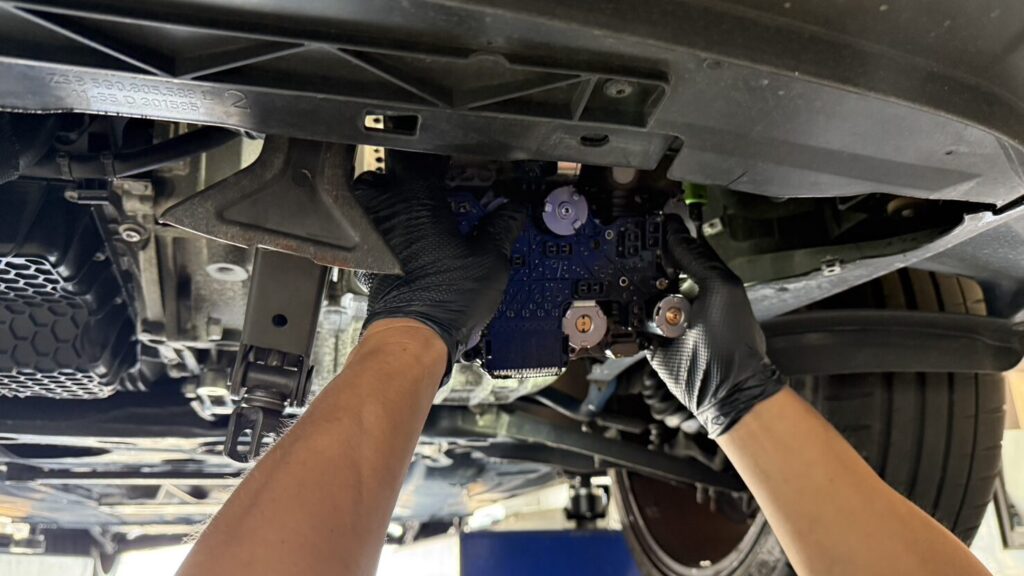
The most common cause.
The following symptoms are easy to occur.
- Shift shock
- Slow like a 2nd gear start
- Self-neutral
- It becomes the N range on its own
(2) Clutch wear (common in dry DQ200)
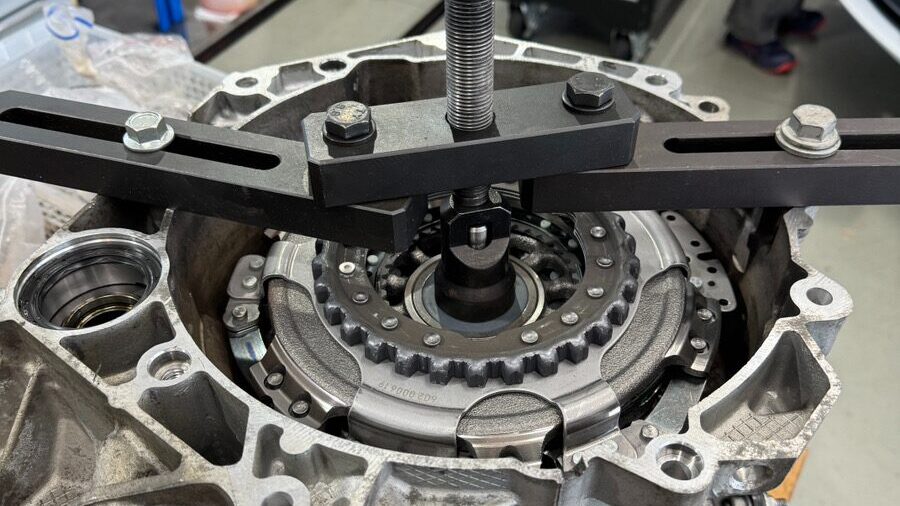
In areas with many traffic jams and slopes, it is prone to wear and tear,
and judder (rattling) may come out and the warning light may come on.
(3) Deterioration of DSG oil (common in wet DSG)
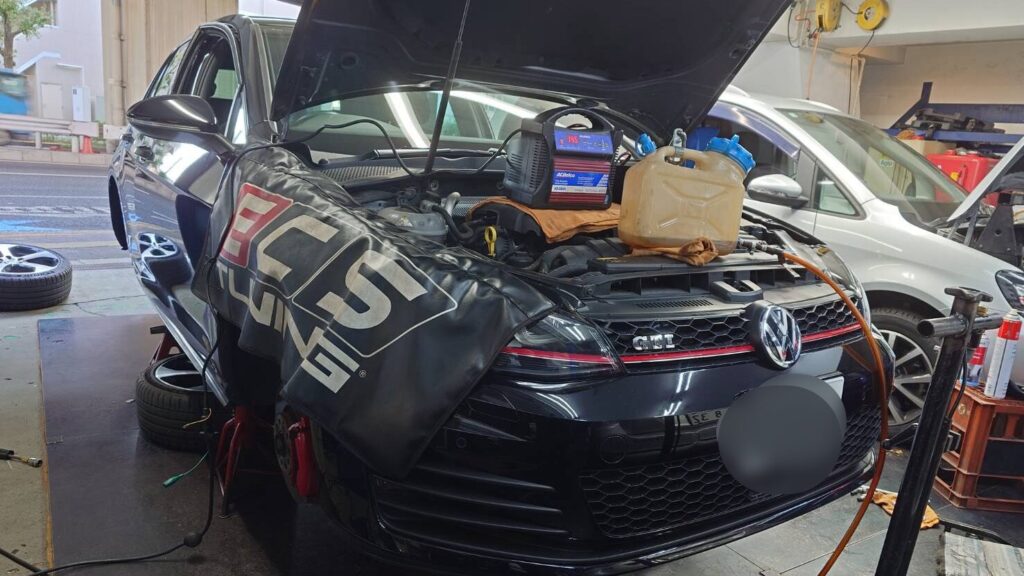
The oil pressure is not stable, and the shift timing is off, recording an error.
(4) Abnormalities in speed sensors and rotation sensors
If the sensor that detects gear rotation is malfunctioning,
the control will be disturbed and the warning light will come on.
(5) Low oil pressure inside the transmission (wet type)
Shifting may not be possible due to a malfunction in the oil pump or a clogged oil circuit.
(6) Low battery voltage
Due to the large number of electronic controls,
it can malfunction with a weakened battery.
Driving when DSG warning light is on
Case that can be driven (yellow)
- You can accelerate
- Shift shock to some extent
- Does not stall
- Symptoms only appear during high temperatures and traffic jams and return immediately.
However, it is safer to avoid driving long distances or on highways.
Cases where driving is not allowed (or very dangerous)
- Red Lamp
- Gear does not enter/quickly becomes neutral
- Don’t start
- Burning smell
- Gurgling and metallic sounds
If the mission is damaged, the repair cost may increase to 20 to 500,000 yen or more.
Correct countermeasures (situational)
Step 1: Stop calmly and in a safe place
In particular, evacuation of red lights is prioritized.
Step 2: Turn off the engine once, leave it for 5 minutes and restart it
Minor errors may disappear.
Step 3: Check the battery voltage
If it is weak, there are examples of replacing it.
Step 4: Check the error code with a diagnostic machine
Since DSG is electronically controlled,
the cause cannot be determined without OBD diagnosis.
Approximate repair cost (general example at VW)
| Contents | Cost estimate |
|---|---|
| DSG oil change (wet) | 2-50,000 yen |
| Mechatronics Repair/Replacement | 10-250,000 yen |
| Dry Clutch Replacement (DQ200) | 10-200,000 yen |
| Wet clutch replacement (DQ250, etc.) | 15-350,000 yen |
| Speed Sensor Replacement | 1-30,000 yen |
| Battery Replacement | 1-30,000 yen |
You can scroll
This is an item that tends to vary depending on the year and mileage.
👉Summary of maintenance and custom costs & working days of VW specialty store Nile Plus
What happens if left unattended?
- Shift shock worsens
- Suddenly becomes neutral when decelerating, etc.
- Becomes completely immobile (requires tower)
- Mechatronic damage (expensive repair)
- Progression of clutch wear
- Breakdowns worsen in high-temperature environments
Be careful because DSG is prone to “chain failures” if left unattended.
Good information to prepare before consulting the factory
- Is the light yellow or red?
- When symptoms appear (traffic jams, slopes, high temperatures, etc.)
- Mission maintenance history (oil change, etc.)
- Recent battery replacement history
- Was there a scene where the gear didn’t go in?
- Is there any abnormal noise?
This alone increases the accuracy of the diagnosis.
FAQ
Q1. What if only the DSG warning light is on and there are no symptoms?
There is a possibility of a minor electrical error, but it is recommended to inspect it because it recurs.
Q2. If it’s yellow, is it okay to run?
It is possible to drive, but it is safe to diagnose it early because it is easy to get worse.
Q3. What if the red light is on and it doesn’t work?
It is safe not to force it and call a tow truck.
Q4. Can DSG oil change cure it?
Wet DSG can be effective.
The dry type is another cause because it does not contain oil.
Q5. Can the battery light up?
It is. DSG is sensitive to voltage drops due to its many electronic controls.
Defect details by vehicle type
Although the “way of getting out” the defect is similar, “which model has many problems” is slightly different for each car model.
Trends by vehicle model and common breakdown cases among other owners are summarized on the following page.




コメント