


Before reading this content, it will be helpful to check the basic knowledge of DSG to deepen your understanding.
👉 DSG Transmission Basics
A 7-speed dry DSG (DQ200) widely used by Volkswagen and Audi .
While its light shifting feel and high fuel efficiency are appealing, many people also have the impression that it is “difficult to use.”
In particular, many people have said that it “vibrates violently when starting” and that “replacing the clutch seems like a difficult task.”
This transmission uses a dual-clutch structure that alternates between two clutches,
which are controlled simultaneously by hydraulics and electronics, resulting in smooth gear changes.
However, because of its delicate structure, improper driving habits or improper maintenance timing can shorten the clutch’s lifespan.
In this article, we will introduce the actual disassembly structure and improvements made by each generation.
- How does a dry DSG clutch work?
- Why does judder (vibration when starting) occur?
- Tips for a long and comfortable ride
We will explain this in an easy-to-understand manner.
Reference video: Nile Mecha Channel “Dry 7-speed DSG clutch replacement”
Reference article: [Clutch replacement] Disassembling and repairing a 7-speed dry DSG! [Causes of judder]
▼Nile Mecha Channel Technical Article Navigation▼
DSG Special Feature
Suspension Special Feature
Engine Special Feature
👉Check out:Nile Mecha Channel (youtube)
Related articles:DSG/Transmission
- Explained: The 6-Speed Wet DSG (DQ250)
- Won’t Move in D Range: Causes of 7-Speed Dry DSG (DQ200) Failure and What to Do
- Does the 7-Speed Dry DSG (DQ200) Need an Oil Change? Costs, Procedure, and Facts
- DQ200 Dry DSG Clutch Guide: Design, Replacement Cost, Judder Symptoms, and Longevity Tips
- Is DSG Judder in the 7-Speed Dry DSG (DQ200) Really Just a Clutch Problem?
- A Complete Guide to the 7-Speed Dry DSG Mechatronics
- Inside the Shop: Rebuilding DSG Mechatronics
- DQ381 Wet DSG Oil Change Guide: When to Service, Cost, Time, and Filter Replacement
- DSG Mechatronics Oil Leak: Causes, Repair Costs, and O-Ring & Gasket Replacement Tips
- [Basic Knowledge] What is the dry 7-speed DSG (DQ200)? An easy-to-understand explanation of its structure and mechanism
- Differences from wet DSG | Comparing the differences in structure, durability, and cooling performance
- What causes judder (vibration when starting)? A detailed explanation of common symptoms of dry DSGs
- Clutch structure and generation differences (Gen1/Gen2) | Improvements and durability
- Causes of clutch wear and the impact of driving habits | What are the habits that shorten clutch life?
- What happens if you leave judder unattended? What to do before the problem gets worse
- Clutch replacement procedure (outline) – Understanding the overall picture of maintenance
- Shim adjustment: Why a 0.1mm difference can change the shifting feel
- The true meaning of the “trick” – Why is clutch cleaning at your own risk?
- Learning and resetting procedures after clutch replacement | Don’t forget to readjust the electronic control
- Tips for extending clutch life | Driving and maintenance habits to extend the life of your dry DSG
- Estimated repair and replacement costs | List of prices for judder, clutches, and mechatronics
- The dry DSG is a “sensitive but responsive transmission”
- Frequently Asked Questions (FAQ)
- We also recommend these articles:
- Details of defects by vehicle type




[Basic Knowledge] What is the dry 7-speed DSG (DQ200)? An easy-to-understand explanation of its structure and mechanism
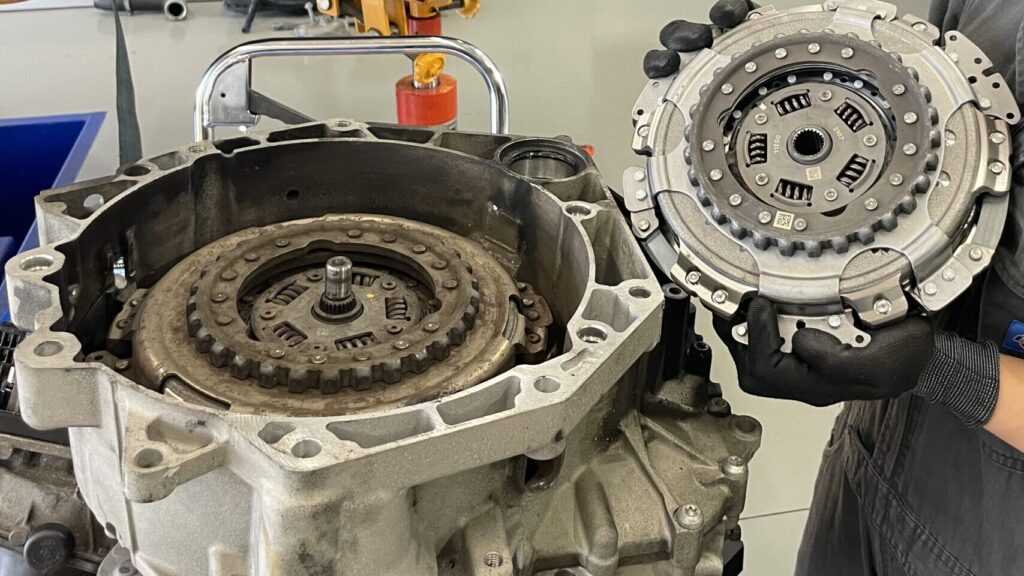
First, let’s briefly explain how the 7-speed dry DSG works.
DSG stands for “Direct Shift Gearbox,” which literally means “a gearbox that changes gears directly.”
Unlike typical automatics (torque converter type), the gears are changed by alternating the movement of two clutches inside .
Basic structure of dual clutch
The 7-speed dry DSG (DQ200) consists of three main units:
- The mechatronics unit
uses hydraulic and electronic controls to push and pull the clutch and control the timing of gear changes. - Dual clutch (K1/K2)
K1 is responsible for odd-numbered gears (1st, 3rd, 5th, and 7th gears), while K2 is responsible for even-numbered gears (2nd, 4th, 6th, and R).
By alternating between them, seamless acceleration is achieved when changing gears. - Gearbox
is a transmission mechanism that transmits engine power to the wheels.
Characteristics of the “dry” structure
Dry clutches are characterized by a structure in which the clutch disc is not immersed in oil.
Because they do not use oil, they have low friction loss, are lightweight, and have high fuel efficiency
. On the other hand, it is difficult to cool the clutch, and they are prone to wear in high-temperature environments such as traffic jams or starting on a hill.
Operation flow
When starting off, the mechatronics hydraulically presses the clutch lever and K1 engages.
While driving, the next gear on the K2 side is prepared in advance, and
at the moment of gear change, it is “quickly switched” to ensure a smooth shift.
This is the mechanism that creates the “instant and pleasant shifting feel” that is unique to DSG.
However, such precise control requires delicate clutch operation, and even
slight wear or deviations in the learning values can cause shift shock and judder.
Differences from wet DSG | Comparing the differences in structure, durability, and cooling performance
Although they are both called “DSG,” the dry type (DQ200) and the wet type (DQ250/DQ381, etc.) have very different structures and characteristics.
Both are dual-clutch systems, but they are used in different situations and have different areas of expertise.
To put it in perspective, the dry type is like a “light city runner” and the wet type is like a “tough athlete.”
Features of the dry DSG (DQ200)
Dry type clutches are simple in structure and lightweight because they are not immersed in oil .
Because there is less resistance from the oil, they offer excellent fuel economy and a stronger sense of direct gear engagement.
They are often used in relatively compact cars, such as the Golf 6, 7, Polo, and T-Cross.
However, because it does not have a cooling mechanism, it does not perform well in “heat-trapping situations” such as traffic jams or starting on a hill.
The temperature of the clutch disc easily rises, which can cause wear and judder (vibration when starting).
Regular oil changes and gentle starting techniques greatly affect the lifespan of the clutch.
Characteristics of wet DSG (DQ250/DQ381, etc.)
On the other hand, the wet type has a structure in which the clutch is immersed in special oil .
This oil absorbs frictional heat and at the same time lubricates and cools the gears and clutch. It
has a large torque capacity and is durable enough to handle high-output engines
. It is used in vehicles with high torque, such as the Golf GTI, Passat, Tiguan, and Arteon.
On the other hand, the structure is more complex, the amount of oil is larger, and the vehicle weight and maintenance costs tend to increase.
Although the fuel economy is slightly lower than that of the dry type, the wet type is superior in terms of stability and reliability .
Comparison table of the two
| Comparison items | Dry 7 speed (DQ200) | Wet 6-speed/7-speed (DQ250/DQ381) |
|---|---|---|
| Cooling method | Air-cooled (not immersed in oil) | Cooling by oil circulation |
| Oil amount | Approximately less than 2L | Approximately 6~7L |
| Torque compatible | Up to approximately 250Nm | Approximately 400Nm or more |
| Maintenance frequency | Early replacement recommended (20,000-30,000 km) | Standard cycle of 50,000 to 60,000 km |
| Vehicle models | Golf 6/7, Polo, T-Cross, etc. | Golf GTI, Passat, Tiguan, etc. |
- DSG oil change | An easy-to-understand explanation of change timing and effects
- Cost and effectiveness of 7-speed wet DSG oil change
- Does a 7-speed dry DSG require no oil changes?
- Explaining the necessity of changing the oil in a 6-speed wet DSG while working
Understanding the differences will help you find the best care
Dry DSGs are designed to emphasize lightness and response, while
wet DSGs are designed to emphasize torque and stability.
In other words, rather than one being superior to the other, they are used depending on the car’s character .
The trick to making a dry DSG last longer is to drive in a way that doesn’t let heat build up and doesn’t burn the clutch.
Judder (vibration when starting), which we’ll explain in detail later, is also largely related to thermal stress on the structure.
What causes judder (vibration when starting)? A detailed explanation of common symptoms of dry DSGs
The most common problem with the dry 7-speed DSG (DQ200) is “judder.”
This is a symptom of a rattling vibration or slipping sensation when starting off. This phenomenon is primarily caused by wear and thermal degradation of the clutch disc
, rather than a DSG control problem .
What is Judder?
Judder
is a phenomenon in which the clutch does not engage smoothly when starting, but instead repeatedly engages and disengages in small, intermittent movements.
This is similar to the “half-clutch not working properly” condition in a manual car.
From the driver’s perspective, the car does not move smoothly even when the accelerator is pressed, and
it feels like the body is shaking violently.
Cause 1: Clutch disc wear
Dry clutches are designed to transmit power through friction, so
over time the disc surface wears down and the friction decreases.
When the friction surface becomes slick, the grip becomes unstable when starting off, and
judder occurs as the clutch repeatedly engages, slips, engages, etc.
This wear tends to occur more quickly , especially in driving environments where the clutch is used frequently in heavy traffic or on slopes .
Cause 2: Thermal deterioration and a burnt clutch
Dry clutches do not have oil cooling, so
if the temperature rises too high, the facing (friction material) hardens and
develops a burnt surface.
This “burnt clutch” has an unstable friction coefficient, and
even if it appears to be connected, it may slip,
causing vibration and shock.
Cause 3: Control error or oil deterioration
The “pushing force” controlled by the mechatronics (hydraulic unit)
can be slightly out of sync due to discrepancies in learning data or oil deterioration.
If the oil pressure is unstable, the clutch will not be pushed with the necessary pressure,
resulting in insufficient friction and causing judder.
In this case, the problem may be resolved by relearning the mechatronics or changing the oil rather than by fixing the clutch itself.
Cause 4: Accumulation of clutch powder
Wear debris from the clutch can accumulate inside the housing and
interfere with the movement of the clutch disc.
When the debris mixes with moisture and oil, it can cause unevenness on the clutch surface,
resulting in uneven contact when starting. At specialized workshops, this debris is removed by disassembling, cleaning, and air blowing
when replacing the clutch .
The main causes of judder in a dry DSG are mechanical wear and temperature rise rather than control .
This means that it is a problem that can be largely prevented with a few simple everyday tips, such as gentle starts, regular oil changes, and using N range when in traffic jams
.
Clutch structure and generation differences (Gen1/Gen2) | Improvements and durability
The 7-speed dry DSG (DQ200) has undergone gradual structural improvements over the 10 years since its introduction.
The biggest changes are to the clutch structure and shim adjustment method.
Understanding these differences
will help you determine which generation of DSG your car has and what maintenance is required.
Early model (Gen1) – delicate but with large individual differences
The early DQ200 was the type that was installed on the Golf 6 and early Beetle.
The clutch lever and shim (adjustment washer) had a complex structure, and the way it
“contacted” had to be fine-tuned for each vehicle.
Because the lever itself is slender and movable,
prolonged use can lead to unstable pressure due to a lack of rigidity,
resulting in a tendency for starting shock and judder to occur.
During maintenance, the thickness of the shim must be adjusted to within 0.1 mm, and
the experience of a skilled mechanic determines the final result.
Improved (Gen2) – Simplified structure for improved stability
An improved model called Gen2 was introduced in the Golf 7 series from around 2011 onwards .
In this generation, the clutch lever shape was changed to a reinforced rigid type, and
the fork rigidity was greatly improved.
Furthermore, the shim adjustment became an internal washer type,
making it easier to assemble while maintaining precision.
As a result, the clutch’s “pushing force” is transmitted more evenly,
making for a smoother starting feeling.
The incidence of judder and shock has also been greatly reduced compared to the earlier model.
If you’re surprised by how quiet it is despite being a dry clutch, you probably have a Gen2 or later model.
Gen1/Gen2 comparison chart
| item | Gen1 (up to around 2011) | Gen2 (2011 and later) |
|---|---|---|
| Lever shape | Slim and movable | Reinforced rigid type |
| Shim structure | external adjustable | Internal washer type |
| rigidity | Somewhat weak | Improvements and improvements |
| Hit Accuracy | There is a large difference between individuals | Uniform and stable |
| Starting feel | A little awkward | Smooth and quiet |
| Example of adopted model | Golf 6, early Beetle, etc. | Golf 7, late Polo, etc. |
Key points to distinguish generations
The clutch unit is stamped with either “LUK” or “SACHS.”
The manufacturing year often varies around 2011, and
you can determine which generation it is by looking at the part number and stamping.
When considering replacement or using a second-hand clutch, it is important to always choose a clutch from the same generation .
In Gen2 , the clutch life and smoothness of starting have been greatly improved by strengthening the rigidity of the clutch lever and fork and improving the shim structure .
The saying that “dry DSGs are prone to breaking” was based on the strong impression of the early models, but
in fact improvements have been made and reliability has increased significantly.
👉 Summary of drive and transmission problems | Repair costs and solutions for DSG, clutch, etc.
Click below to jump to articles about engine, drive, exhaust, and cooling system problems and repair costs.
Causes of clutch wear and the impact of driving habits | What are the habits that shorten clutch life?
The dry 7-speed DSG (DQ200) uses mechanical friction to transmit power, so
daily driving habits have a direct impact on the lifespan of the clutch. Simply being mindful of
“gentle starts” and “operating in a way that avoids unnecessary heat buildup”
can make a big difference in the lifespan of your clutch.
Frequent use of the half-clutch is your biggest enemy
Dry DSGs will wear out quickly if the clutch is used in a semi-engaged state, where the clutch slips slightly, when driving in traffic or starting on an uphill slope .
Just like manual transmissions, the friction material (facing) wears down,
causing judder and poor clutch engagement when starting.
Be especially careful when holding the brake pedal in D for long periods of time .
Because the clutch is receiving force while still slightly in contact,
wear is constantly progressing in ways you can’t see.
Stop & Go (short distance travel) leads to insufficient cooling
When driving short distances repeatedly, such as shopping or taking children to and from daycare,
the clutch heats up easily and does not have enough time to cool down.
Because dry structures do not have oil cooling,
heat builds up, causing the facing to harden and the friction coefficient to become unstable.
As a result, judder (rattling when starting) is more likely to occur.
On slopes, apply the handbrake first
When starting on a slope, “quickly switching from the brake to the accelerator”
can cause the clutch to rub hard. If you apply and hold the handbrake (or electric parking)
before starting , you can reduce the load on the clutch. This single operation can significantly reduce the start-up shock and heat buildup.
Use the auto-hold function frequently
Recent VW cars are equipped with an “Auto Hold” function. This
automatically holds the car in place when waiting at traffic lights, etc., so
the clutch remains disengaged.
This means that the clutch is not left in a partially engaged state, which helps prevent wear.
Simply using Auto Hold can significantly reduce the temperature rise of the clutch.
Driving environment and wear level
| Operation status | Clutch load | remarks |
|---|---|---|
| Frequent use of half clutch (traffic jams, hills) | large | Accelerates wear and burns easily |
| Stop & Go (short distance travel) | large | Hot spots and insufficient cooling |
| Frequent highway use | small | Stable and low wear |
| Auto hold combined | medium to small | Effective in reducing shock when starting |
The lifespan of a clutch is determined not only by the quality of the parts, but also by the driver’s habits .
Avoid sudden acceleration and let the car rest in N range or auto-hold while stopped.
Just by doing this, you can significantly extend the distance before the clutch needs to be replaced.
Remember that the DSG is a mechanism that responds better the more carefully it is treated.
What happens if you leave judder unattended? What to do before the problem gets worse
When starting off, you may feel a slight shudder or jerking noise.
At first, you may think it’s just a minor issue, but
in fact, this symptom is the beginning of a warning sign for the DSG clutch .
If you continue to drive without any treatment, wear and heat damage will progress rapidly, and
in some cases, the car may eventually become unable to be driven.
1. Clutch facing seizure
If judder continues, the surface of the clutch disc will be exposed to high temperatures,
causing the friction material (facing) to harden and discolor.
If the facing becomes burnt, the friction force will become uneven, and
the clutch will no longer be able to properly engage and disengage.
As a result, the shock when starting and the jerky feeling when changing gears get worse,
and eventually the clutch starts to slip completely .
Once it reaches this stage, clutch replacement becomes unavoidable, and
repair costs will balloon to around 200,000 to 300,000 yen.
2. Mechatronic pressure control goes awry
The DSG’s mechatronics meticulously learns how much force to apply (pressure value) depending on the wear of the clutch . If
the clutch slips due to judder or
friction becomes uneven, this control value will become misaligned.
As a result, the hydraulic pressure becomes unstable, leading to more serious problems
such as “the car won’t move even when in D range” or “the wrench mark comes on.”
At this stage, mechatronic repairs (approximately 150,000 to 250,000 yen) will be required.
3. Deformation of surrounding parts due to thermal expansion
If the clutch continues to slip, the internal temperature can exceed 100°C.
This can cause the housing and bearing sleeve to slightly distort,
causing the mechatronics to become misaligned.
Once the clutch is distorted, the contact between the metal parts changes,
and even if a new clutch is installed, the judder may remain.
In other words, the longer the period of neglect, the higher the risk of the problem recurring after repair .
4. Early detection and countermeasures are the best value for money
If the problem is only slight vibration when starting off or occasional shocks, it may be possible to improve the situation by resetting the learning process or changing the oil
, even if you do not need to replace the clutch itself .
On the other hand, if the burnout progresses, replacement is necessary. The best way to minimize expenses
is to have it checked by a specialist while the symptoms are still mild .
Judder is a warning, not a sign
DSG judder is a sign that the car is telling you that the clutch is nearing its limit.
If left unattended, damage will occur in the following order: clutch, mechatronics, housing.
Don’t just think, “It’s just a light vibration, so it’s okay,” but
having it inspected and adjusted early will ultimately protect both your car and your wallet.
Clutch replacement procedure (outline) – Understanding the overall picture of maintenance
7-speed dry DSG clutch replacement
Replacing the clutch on a dry 7-speed DSG (DQ200) is a more delicate task than it looks.
It’s not just a matter of removing the old one and replacing it with a new one; it requires
precise adjustment (shim adjustment) in 0.1mm increments and a learning reset
. Here we’ll explain the entire process in an easy-to-understand way.
Step 1: Remove the DSG unit from the vehicle
First, the entire transmission is removed from under the car.
This process alone is quite time-consuming, and
requires removing the engine mounts and auxiliary components.
Dry DSGs are relatively light, but the entire transmission must be removed
to replace the clutch .
Step 2: Separate the mechatronics
Next, the “mechatronics unit” that controls the hydraulic pressure is removed. This is a delicate part
where the electronic board and hydraulic valve are integrated, and even the slightest impact or dirt can cause a malfunction. The mechanic carefully removes it, taking measures against static electricity and preventing oil from entering.
Step 3: Remove the clutch assembly
Once the mechatronics is removed, the clutch assembly will appear at the back.
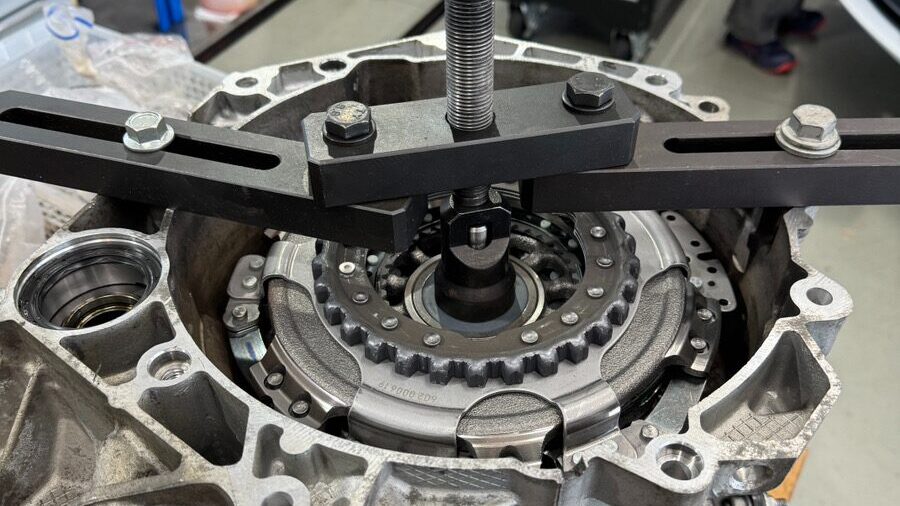
Remove the C-ring (fixing ring) and
take out the two clutches (K1 and K2) together.
At this point, check the condition of wear and the degree of burnt surface of the facing (friction material).
If there is a lot of burnt material or powder, this is a sign that the engine was subjected to strong thermal stress when starting .
Step 4: Install the new clutch
When installing a new clutch,
first clean and degrease the inside of the housing before pressing it in.
The clutch is pressed in evenly using a special SST (Service Special Tool)
to ensure the center position is not shifted.
If this process is not performed carefully, uneven contact will occur when starting,
which will again cause judder.
Step 5: Shim adjustment (most important step)
The most important part of a clutch replacement is setting the shims (adjustment washers).
The “contact thickness” of the two clutches, K1 and K2, is measured to within 0.1mm and
adjusted so that the pressure is within the specified range.
If this precision is not met, symptoms such as starting shock, gear slippage, and slippage will occur.
At specialty shops, measurements are made using a special jig or dial gauge, and fine adjustments are made.
Step 6: Reinstall the mechatronics and reset the learning
Once the clutch is assembled, the mechatronics is replaced and
the bolts are tightened while controlling the torque. After that, a basic learning of the clutch
is carried out using a diagnostic device (VCDS or genuine VAS) . The clutch stroke and pressing timing are reset, and a test drive is carried out to check for any shifting shock.
High-precision maintenance determines the service life
The outcome of a dry DSG clutch replacement depends greatly on the experience and precision of the mechanic.
In particular, if the “shim adjustment” and “learning reset” are not performed correctly,
the problem may recur after a few thousand kilometers even after replacing the clutch with a new one.
For this reason, we recommend having a professional workshop perform a detailed maintenance rather than simply replacing the part .
This is why the “smoothness of the finish” can vary greatly even with the same clutch replacement.
👉 Summary of maintenance and customization costs and work days at VW specialty store Nile Plus
Shim adjustment: Why a 0.1mm difference can change the shifting feel
The most important step in replacing the clutch on a dry DSG (DQ200)
is “shim adjustment.”
This is
a fine-tuning process that adjusts the clutch pressure to a precision of less than a millimeter, ensuring that force is transmitted correctly.
In other words, it is such a delicate process that a difference of 0.1 mm can determine whether or not there is a shift shock .
What is a Sim? What is their role in a nutshell?
A shim is a thin metal washer (spacer)
that is placed between the clutch disc and housing
to fine-tune the initial position at which the clutch is pressed.
This allows the optimum pressing distance to be determined for each vehicle, preventing the clutch from engaging too early or too late .
Why is precision of 0.1mm required?
For example, if the shim is slightly too thick,
the clutch will always be pressed hard, causing the car to run in a partially engaged position,
resulting in judder when starting and a burnt clutch .
On the other hand, if it is too thin, there will not be enough pressure, causing the gears to slip and
not mesh completely,
resulting in unstable torque transmission.
In both cases, stress is placed on the transmission, and
in the worst case scenario, the load is concentrated on the clutch and mechatronics, leading to premature failure.
Measurement and Adjustment Process
When replacing a clutch, specialized workshops will perform adjustments using the following procedure.
| Measurement items | Content | the purpose |
|---|---|---|
| K1 clutch distance | Measure the pressing distance of the outer clutch | Wear compensation and pressure equalization |
| K2 clutch distance | Measuring the pressing distance of the inner clutch | Same as above |
| Calculation of average and corrected values | Adjust the difference between the two to within the specified value (±0.1 mm) | Ensures accurate actuation points |
You can scroll
After the measurement, we reassemble the system several times, selecting different combinations of shim thicknesses, and
check the hydraulic operation to determine the final value.
Experienced mechanics’ “sensory correction”
Even if the theoretical values are correct, slight errors will occur during actual assembly.
For this reason, experienced mechanics
make fine adjustments by not only looking at the measurements, but also at the clutch movement, response, sound, and assembly resistance.
Whether or not this “feeling correction” is performed
makes a big difference in the starting feel and shift response after the replacement. The reason why
it is said that “even if the same parts are used, the finish will vary depending on the shop”
is precisely because the precision of this process differs.
Shim adjustment is the heart of DSG
Shim adjustment may look like a simple washer replacement, but it is
actually an adjustment that can affect the life of the clutch .
Even a deviation of just 0.1mm can change the behavior of the entire DSG.
To ensure long-term, comfortable use of a dry DSG,
it is not just about replacing parts, but the quality of this precise adjustment that is most important.
Even repair shops that usually focus on Japanese cars will be able to accept more European cars if they understand the procedures and precautions for servicing
them. If you’re preparing your shop to handle imported cars, check out Yolost, which offers a wide range of maintenance supplies and work environment items
. They stock items that are useful for any manufacturer’s vehicle, including wiring, batteries, and engine oil.
Many of their products are easy to use even for beginners, making them a great first step in DIY maintenance .
The true meaning of the “trick” – Why is clutch cleaning at your own risk?
As the name suggests, the dry DSG (DQ200) is a design in which the clutch is not immersed in oil.
This means that the powder produced by friction (clutch powder) does not wash away with the oil, but remains inside the housing .
This powder can sometimes cause judder when starting off.
Therefore, while some people have been spreading information that “cleaning will improve the situation,” it is
actually a high-risk maintenance procedure .
What is clutch powder?
When a clutch wears, the facing (friction material) is scraped off and turns into powder.
This phenomenon occurs in manual transmission vehicles as well, and is unavoidable in dry clutch structures.
Normally, the powder remains inside the case and does not directly affect clutch operation, but
if the powder mixes with moisture or oil, it can become sticky and cause clutch movement to slow down.
If this condition continues, the connection when starting off will become uneven and judder may recur.
The concept of cleaning – “disassembly and cleaning”
At specialized workshops, when replacing or overhauling a clutch,
the inside of the housing is carefully disassembled, cleaned, and air-blowed
. The basic procedure is to remove all parts, blow away any dust, and keep the metal surface dry.
This “dry cleaning” is safe and effective, but
it’s a completely different approach to the “water and solvent cleaning” you see on YouTube.
If moisture remains, it can cause rust on the clutch and bearings,
and even cause sensor malfunctions and poor contacts .
What are the risks of “water spray cleaning”?
In the video, there is an example of rinsing the inside of the clutch housing with water, but
this is an experimental method and is not included in the maintenance manual
.
- Clutch facing expansion
- Grease leakage
- There is a risk of problems such as oxidation (rust) of metal parts .
Even if the judder appears to be reduced temporarily,
the symptoms will return if powder is generated again, and it may actually accelerate deterioration.
A safe method performed in specialty stores
At VW specialty stores, when replacing a clutch, we safely clean it using the following steps.
| process | Content |
|---|---|
| Decomposition | Clutch and mechatronics are completely separated |
| cleaning | Remove powder with air blower and dry brush |
| confirmation | Check the inside of the housing for wear and heat marks |
| Reassembly | Press-fit and adjust the clutch in a dry state |
This method prevents powder from re-adhering while
maintaining accurate clearance in the clutch operating area.
Avoid DIY and have it done at a specialized factory
Although clutch powder cleaning may seem like a quick fix, it is
actually risky and may be counterproductive in the long run.
If you are concerned about judder or slippage, it is best to prioritize clutch wear inspection and learning reset
rather than clutch cleaning .
The dry DSG is a precision device.
Rather than trying to remove the dust from the parts you can’t see,
it is more effective to extend its lifespan through proper maintenance and gentle driving.
Learning and resetting procedures after clutch replacement | Don’t forget to readjust the electronic control
In the dry 7-speed DSG (DQ200), the clutch and mechatronics are electronically controlled
. This means that even if parts are replaced with new ones, if the computer (ECU) still stores the “old pressing force data,”
the clutch will not move with the intended force.
The process of resetting and readjusting this is called a “learning reset.”
What does learning reset do?
During the learning reset, the mechatronics (hydraulic unit) reconfirms the clutch “pressing position.”
It’s like returning a computer mouse to its initial position.
The ECU recognizes that “this amount of pressing will engage the clutch,”
allowing for smoother starts and gear changes.
If you drive without resetting,
- Jerky when starting
- Shift shock
- Problems such as the gear not engaging or slipping
may occur.
Diagnostic procedure (overview)
A specialist workshop will reset the VCDS or VW’s original diagnostic software (VAS).
The general procedure is as follows:
| procedure | Content |
|---|---|
| 1 | Place the vehicle in a horizontal position and start the engine |
| 2 | Select “Basic Settings” mode on the diagnostic tester |
| 3 | Access to DSG control unit (02) |
| 4 | Initialize the clutch → Execute stroke learning |
| 5 | Remeasure the pressure and release points of each clutch (K1/K2) |
| 6 | Save the results and reboot |
This process takes about 10 to 15 minutes,
during which the mechanic will check for any shifting shocks or strange noises.
Driving tests are also part of the “learning” process
After resetting, the system will automatically adjust the fine control while driving.
The DSG records the oil temperature and how you press the pedal while driving, and
gradually optimizes the clutch “engagement method.”
Therefore, even if the feeling is a little stiff immediately after replacement,
it will gradually become more comfortable after driving about 100km.
This natural change is also a feature unique to electronically controlled DSG.
Note: DIY reset is not recommended.
Although some websites claim that resetting the OBD function can be done easily with an OBD tool, there is a risk that
incorrect procedures can lead to clutch malfunctions due to incorrect learning
. In particular, if you reset the hydraulic pressure when it is unstable,
an incorrect pressure value may be stored, making it impossible to restart.
Therefore, it is safest to have the reset done at a specialized workshop that is familiar with DSGs .
Learning reset is “electronic fine-tuning”
The learning reset after replacing the clutch
is an electronic fine-tuning process to synchronize the mechatronics and the clutch.
By doing this correctly, you can restore smooth gear changes without shock when starting, and
maximize the performance of the new clutch.
It is no exaggeration to say that replacing the clutch is the “first half of maintenance” and
resetting the learning is the “second half.”
Reference video: Nile Mecha Channel “Dry 7-speed DSG clutch replacement”
Reference article: [Clutch replacement] Disassembling and repairing a 7-speed dry DSG! [Causes of judder][Clutch replacement] We will disassemble and repair the 7-speed dry DSG! [Cause of judder]
Tips for extending clutch life | Driving and maintenance habits to extend the life of your dry DSG
The dry 7-speed DSG (DQ200) is a transmission that excels in fuel economy and agility, but
because it transmits power through clutch friction, its lifespan can change dramatically depending on how it is handled.
Conversely, if used correctly, it has the potential to last comfortably for over 100,000 km .
Here we will introduce some driving habits that you can start practicing today to help maintain your DSG for a long time.
1. Avoid keeping the gear in D range when in traffic
If you keep pressing the brake pedal while in D range while waiting at a traffic light or in a traffic jam,
the clutch will be in a slight contact state (half-clutch), which will cause wear.
If this state continues for a long time, the facing (friction material) will burn and its lifespan will be shortened.
If you think you’ll be stopping for a long time, the best thing to do is put the car in N range (Neutral) .
If your car has an auto-hold function, you can just release the brake pedal.
2. On a slope, pull the handbrake first
If you shift into P range first on a slope,
the weight of the vehicle (driving force) will be directly applied to the gears.
If this happens repeatedly, it can put strain on the clutch and fork structure.
The correct procedure is
- Stop with the brakes on
- Activate the parking brake (or electric parking) first
- Make sure the car has come to a complete stop before shifting into P range.
By simply following this order, stress on the clutch and mechatronics can be significantly reduced.
3. When starting, be mindful of “gentle connections”
With a dry DSG, accelerator operation when starting off has the greatest impact on its lifespan.
If you press hard, the clutch will engage all at once, causing wear and heat all at once.
Try to start gently by pressing the accelerator slowly and engaging smoothly.
It is especially effective in situations where you need to start and stop repeatedly, such as when stuck in traffic or parking.
4. Don’t forget to change your oil regularly
It is often thought that “dry-type clutches do not require oil changes,” but
in fact lubricating oil is used in the gear and mechatronic parts.
If this oil deteriorates, hydraulic control becomes unstable and
has a negative effect on clutch pressure control.
Replacing the brakes every 40,000 to 50,000 km will help maintain smooth shifting and durability.
5. Observe your car’s habits and have it inspected early
DSG has a very sensitive structure.
If you experience a persistent “sticking” or “light shock” when starting,
this may be a sign of clutch wear or a malfunction in the hydraulic control.
If you don’t leave it and have it checked at a specialist store as soon as possible,
in many cases it will be possible to make adjustments before parts need to be replaced.
Ride while giving the clutch a rest
With a dry DSG, rhythmic driving is more important than speed .
For example, rather than moving quickly in a traffic jam,
starting slowly with a little distance between you and the car will reduce the strain on the clutch.
The clutch will last longer if you allow it time to relax. By simply being mindful of these three things
– gentle starts, proper stops, and regular inspections –
you can maintain the performance of your DSG for a long time.
Estimated repair and replacement costs | List of prices for judder, clutches, and mechatronics
While the dry 7-speed DSG (DQ200) is precisely manufactured,
if a problem occurs, the cost of repair varies greatly depending on the nature of the problem.
Here, we have compiled a table that clearly shows the repair costs for each of the most common problems.
(*All prices are approximate prices including tax. Actual estimates will vary depending on the vehicle model and factory.)
Estimated repair costs by symptom
| Symptoms/Causes | Repair details | Estimated cost (tax included) | remarks |
|---|---|---|---|
| Judder (vibration) when starting | Clutch replacement and shim adjustment | Approximately 200,000 to 300,000 yen | Includes parts, removal and learning reset |
| Spanner mark lights up/gear shifting not possible | Mechatronics on-site repair | Approximately 150,000 to 250,000 yen | Accumulator replacement, O-ring restoration, etc. |
| It goes into D and R but doesn’t work | New mechatronics replacement | Approximately 350,000 to 450,000 yen | Guaranteed support available |
| Shock when changing gears | DSG oil change and initialization | Approximately 20,000 to 40,000 yen | It may be possible to improve minor hydraulic misalignment. |
| A sudden shock while parked | Learning reset/readjustment | Approximately 10,000 to 20,000 yen | Conducted using a dedicated diagnostic machine |
| Oil seepage/leakage | Seal and gasket replacement | Approximately 30,000 to 60,000 yen | If left unattended, it can lead to internal damage |
| Mechatronic malfunction + unable to drive | Mechatronics + clutch simultaneous repair | Approximately 400,000 to 600,000 yen | Cases where complex repairs are required |
The main points that affect costs
1. Differences in generation and model number:
The mechatronic structure is different between the Golf 6 series and Golf 7 and later, so there will be differences in repair methods and part prices.
2. New or refurbished?
New parts are expensive, but using refurbished mechatronics (repaired parts) can save you around 100,000 yen.
3. Dealer or Specialty Shop?
Dealers generally focus on replacing parts with new ones, while specialty shops specialize in repairs and refurbishment.
The cost and delivery time will vary greatly depending on which shop you choose.
Tips for keeping repair costs down
- Check while the problem is minor : If the problem is only mild judder or a warning light, a re-learning or oil change may be all that is needed.
- Don’t neglect oil management : Change the DSG oil every 20,000 to 30,000 km to prevent internal heat damage.
- Operate carefully : The lifespan of the transmission can be affected by how you handle it on a daily basis, such as avoiding keeping it in D range on slopes or in traffic jams.
Prevention is the best way to save money, rather than neglecting it
Although dry DSGs are expensive to break,
most of these problems can be prevented with early detection .
If you notice any slight issues, have it checked at a specialist workshop as soon as possible,
which can avoid the need for part replacement and ultimately save you hundreds of thousands of yen.
You can jump to an article that explains the costs and effects of each.
👉 Summary of maintenance and customization costs and work days at VW specialty store Nile Plus
The dry DSG is a “sensitive but responsive transmission”
The 7-speed dry DSG (DQ200) is lightweight and efficient, making
it an ideal transmission for small-displacement VWs and Audis. However, it is often the subject of discussion about specific problems
, such as “judder when starting,” “not being able to shift gears,” and “not being able to shift into both D and R but not moving .”
However, this is not a defect, but rather a “characteristic” that emerges due to the delicate structure.
DSG honestly receives the influence of the driver’s operation and the environment, so
if used correctly, it is a very “obedient” mechanism that responds accordingly.
“Understanding and riding” can change both the lifespan and comfort of your car.
Dry clutches are sensitive to heat and wear, but by
gently stepping on the accelerator when starting off and
applying the handbrake before stopping , you can surprisingly reduce the strain on the clutch and forks.
In addition, if you regularly change the DSG oil and perform a learning reset,
gear shift shock and judder will be reduced, and long-term stability will be greatly improved.
In other words, the true value of a DSG is that “how it is handled affects both its lifespan and comfort.”
To prevent problems before they occur
If you notice signs such as the wrench symbol lighting up, jerking when starting, or strange noises,
it’s not that your bike is broken, but rather that it’s calling for help.
Early inspection can prevent major repairs such as stuck forks or worn clutches.
Don’t try to ride it, but consult a trusted specialist shop.
Delicate, so you can enjoy it for a long time
The dry DSG is a precision mechanism that looks like it was made by hand by a craftsman.
If handled carefully, it will continue to shift smoothly even after 100,000 km, and
every time you drive it, you will feel that “DSG really is a pleasure.”
Rather than being “easy to break,” the 7-speed dry DSG (DQ200) is a
transmission that responds well if driven carefully .
Reference video: Nile Mecha Channel “Dry 7-speed DSG clutch replacement”
Reference article: [Clutch replacement] Disassembling and repairing a 7-speed dry DSG! [Causes of judder]
Frequently Asked Questions (FAQ)
Q1. If judder occurs, do I have to get it repaired immediately?
If the judder is mild, it may be improved by a re-learning reset or oil change
. However, if the judder “vibrates every time you start” or “it’s particularly strong when starting on a hill,”
it may be due to clutch wear or a malfunction in the mechatronic control.
If left unattended, repair costs will increase, so we recommend having it inspected as soon as possible .
Q2. What is the clutch life of a dry DSG?
It depends on how you drive, but the average lifespan is around 60,000 to 80,000 km.
However, if you drive in traffic jams or drive short distances a lot, the tires may start to wear out after 30,000 to 50,000 km.
On the other hand, if you mainly drive on highways, they may last for over 100,000 km.
Q3. Is it better to get repairs done at a dealer or a specialist shop?
Dealers focus on replacing parts with new ones , which is reliable but expensive.
On the other hand, VW specialty stores offer on-site repairs and refurbished parts
, so they have the advantage of being able to keep costs down and provide flexible service.
If the symptoms are mild, we recommend having a specialist store diagnose the problem first.
Q4. Which is more likely to break: mechatronics or clutches?
Both are sensitive to heat and hydraulic pressure, but this differs depending on the operating environment.
- Traffic jams and many hills → Clutch wears out quickly
- Long distances and high temperature areas → Mechatronics are prone to thermal degradation,
but in both cases, oil changes and proper operation can extend their lifespan.
Q5. Are there any driving tips to prevent judder?
Yes, just being aware of the following three things can make a big difference.
- When starting, press the accelerator slowly (avoid sudden acceleration)
- Use the handbrake first on a slope
- When in traffic, instead of “maintaining D range”, take a breather in N range
By simply following these three steps, you can prevent the clutch temperature from rising and significantly reduce the occurrence of judder.
Q6. Will the judder come back after repairs?
Yes, there is.
Most of the time, this is due to an error in shim adjustment or insufficient learning reset .
It is important to have the work done at a trusted specialist store, and to always perform a “basic adjustment (clutch learning)” after replacement.
Even if you feel a slight discomfort immediately after driving, it may settle in and improve after driving several dozen kilometers.
Q7. So is the dry DSG a “no-no” after all?
No.
The dry DSG (DQ200) is an excellent transmission due to its light weight, low fuel consumption, and quick response
. However, because of its delicate structure, its lifespan can vary greatly depending on how it is handled.
If you understand its structure and drive it accordingly, it is a highly reliable mechanism that can be used comfortably for a long time.
Disclaimer:
This article provides a general technical explanation of the structure and clutch replacement of a 7-speed dry DSG (DQ200).
Specialized tools, measuring jigs, and diagnostic equipment are required for the actual work.
Performing the work yourself can be dangerous, so be sure to have it done at a specialized workshop.
We also recommend these articles:
- Volkswagen Abnormal Noise Diagnostic Guide | Causes, Repair Costs, and Urgency
- Summary of causes of poor running performance | Check points when your car won’t move forward, is unstable, or vibrates
- A comprehensive guide to VW suspension problems, repairs, and maintenance | Basics of bushings, suspension, bearings, and alignment, and symptom-specific checks
▼List of individual articles on DSG repair and maintenance▼
Details of defects by vehicle type
Even if the “way” of the malfunction is similar, “which model has the most common problems” differs slightly depending on the model.
The following page summarizes the trends by model and common malfunction cases among other owners.



コメント