


Before reading this content, it will be helpful to check the basic knowledge of DSG to deepen your understanding.
👉 DSG Transmission Basics
Quick reference table
| Work content | Cost (tax included) | Contents/Notes |
|---|---|---|
| DSG oil change (dry 7-speed) | Approximately 15,000 to 25,000 yen | Oil and labor included (approximately 1.7L replacement) |
| Inspection and diagnosis fees | Approximately 3,000 to 5,000 yen | Mechatronics operation check/leak check |
| Reuse/replace drain bolt | Approximately 1,000 to 2,000 yen | Please check as it is an integrated seal |
| Estimated total | Approximately 18,000 to 30,000 yen | General repair shop or VW specialty store standard |
Have you ever heard that “7-speed DSGs do not require oil changes”?
It is true that dealers sometimes advertise them as “maintenance-free.”
However, in actual repair work, there are many problems caused by oil deterioration in the hydraulic unit and gears .
The 7-speed dry DSG (DQ200) is used in a wide range of vehicles, including the Golf 7, Polo, and Passat 1.4TSI.
The clutch section has a dry structure and does not use oil, but special oil circulates through the gear mechanism and mechatronics .
Leaving this oil unreplaced can lead to gear shift shock, gear noise, and mechatronic malfunctions .
This article explains the structure of a 7-speed dry DSG and why oil changes are necessary.
It also provides a comprehensive summary of when to change the oil, how much oil to use, an overview of the work procedure, and points to note when doing it yourself.
Reference video: Nile Mecha Channel “7-speed dry DSG oil change”
Reference article: 7-speed dry DSG oil change method and precautions – Golf 6C Polo
▼Nile Mecha Channel Technical Article Navigation▼
DSG Special Feature
Suspension Special Feature
Engine Special Feature
👉Check out:Nile Mecha Channel (youtube)
Related articles:DSG/Transmission
- Explained: The 6-Speed Wet DSG (DQ250)
- Won’t Move in D Range: Causes of 7-Speed Dry DSG (DQ200) Failure and What to Do
- Does the 7-Speed Dry DSG (DQ200) Need an Oil Change? Costs, Procedure, and Facts
- DQ200 Dry DSG Clutch Guide: Design, Replacement Cost, Judder Symptoms, and Longevity Tips
- Is DSG Judder in the 7-Speed Dry DSG (DQ200) Really Just a Clutch Problem?
- A Complete Guide to the 7-Speed Dry DSG Mechatronics
- Inside the Shop: Rebuilding DSG Mechatronics
- DQ381 Wet DSG Oil Change Guide: When to Service, Cost, Time, and Filter Replacement
- DSG Mechatronics Oil Leak: Causes, Repair Costs, and O-Ring & Gasket Replacement Tips
- [Basics] What is the 7-speed dry DSG (DQ200)? An easy-to-understand explanation of its structure and features
- Is “No Oil Change Required” a Misconception? Uncovering the Truth Behind Dealer Explanations
- [Important] The necessity of changing the oil in a 7-speed dry DSG and the risks of neglecting to do so
- Oil change interval and oil amount guideline
- Types of oil to use and how to choose | Differences between genuine and aftermarket oils and recommended brands
- Overview of the replacement procedure: Workflow explanation to understand how it works
- Things to be aware of when replacing your DIY: Common mistakes and safety measures
- Effects and changes in sensation after replacement: What actually happens?
- Estimated replacement cost and cost performance evaluation
- Frequently Asked Questions (FAQ)
- Summary of tips for extending the life of a 7-speed dry DSG
- We also recommend these articles:
- Details of defects by vehicle type




[Basics] What is the 7-speed dry DSG (DQ200)? An easy-to-understand explanation of its structure and features
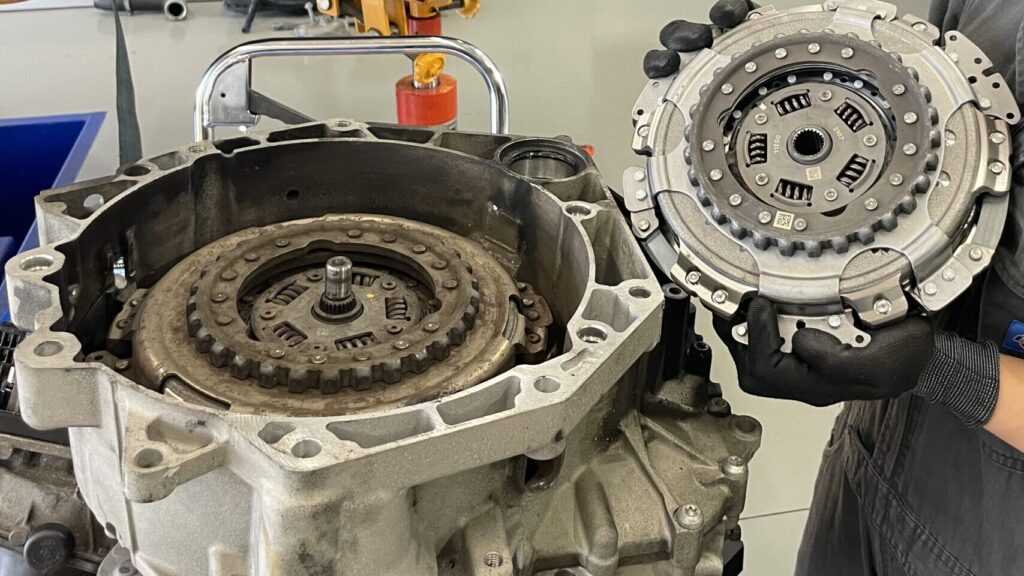
The dual-clutch transmission (DSG) developed by Volkswagen
is a technology that is synonymous with VW, achieving highly efficient and sporty gear changes.
Among them, the 7-speed dry DSG (model: DQ200)
is widely used in vehicles equipped with relatively compact engines, such as the Golf 7, Polo, and Passat 1.4TSI.
As the name “dry type” suggests, the clutch is not immersed in oil .
In other words, unlike the wet type (DQ250 and DQ381) which uses oil to cool the clutch,
only the gear part is lubricated with oil.
Therefore, while it is lightweight, efficient, and has excellent fuel economy, it is not suitable for high-torque vehicles.
Inside, the gear section and mechatronics (hydraulic control unit) are independent structures
, and the mechatronics side generates hydraulic pressure using an electric pump and accumulator.
This mechanism allows the clutch to be switched in an extremely short time,
providing a driving feel that is unimaginable for an automatic transmission.
The comparison table below makes it easy to see the difference with the 6-speed wet type (DQ250).
| item | Dry 7 speed (DQ200) | Wet 6 speed (DQ250) |
|---|---|---|
| Torque compatible | ~250Nm | ~350Nm or more |
| Cooling method | Air-cooled, dry clutch | Oil cooling (wet) |
| Oil Type | Gear lubricant only | Transmission oil + clutch oil |
| Replacement guideline | Approximately 40,000 to 50,000 km (recommended) | Approximately 60,000 km (officially recommended) |
You can scroll
While dry DSGs are light, fast, and fuel-efficient, they are susceptible to heat and wear particles because they use less oil, so
regular oil changes are an important factor in determining their lifespan.
- DSG oil change | An easy-to-understand explanation of change timing and effects
- Cost and effectiveness of 7-speed wet DSG oil change
- Does a 7-speed dry DSG require no oil changes?
- Explaining the necessity of changing the oil in a 6-speed wet DSG while working
Is “No Oil Change Required” a Misconception? Uncovering the Truth Behind Dealer Explanations
Many people may have been told that “7-speed DSGs do not require oil changes.”
Indeed, the dealer’s maintenance manual states that the car is “maintenance-free.”
This is not an error, but is due to a maintenance design that is only intended for use within the warranty period .
Background of “maintenance-free” design
Unlike wet-type DSGs, the 7-speed dry DSG (DQ200) does not use oil in the clutch area.
For this reason, it is often misunderstood that “no need to change the clutch oil” means that the entire system does not need to be changed.
However, in reality, a special oil circulates through the gear mechanism and mechatronics
. This oil also serves as the hydraulic fluid that drives the electric pump and accumulator, and
plays the important roles of lubrication, cooling, and pressure transmission.
In other words, “maintenance-free”
refers to the design of the clutch being dry, and
does not mean that the lubricating oil on the gear side does not need to be replaced.
What about in actual maintenance sites?
In actual practice, there have been reports of gear shift shocks, gear squealing, and even mechatronic malfunctions due to oil deterioration once the vehicle has traveled more than 50,000 km .
Deteriorated oil contains metal wear particles and heat-degraded components,
causing sludge to adhere to the solenoid and oil passages,
which can lead to unstable hydraulic pressure and malfunctions.
In Europe, regular replacement every 50,000 to 60,000 km is already recommended.
Taking into account differences in climate and driving environment, it would be ideal to have the same intervals in Japan as well.
“No replacement required” does not mean “permanently no replacement”
When manufacturers say “no replacement required,”
it is based on the assumption that the parts will last until the warranty period (generally 5 years or 100,000 km).
In other words, “lasting for several years from the time of purchase” does not mean “no replacement required for the rest of your life .”
If you want to continue riding your bike even after the warranty period has expired,
changing the oil will definitely extend the life of the mechatronics and gear parts.
The phrase “no replacement required” lies in the assumption that problems are unlikely to occur within the warranty period.
If you want to drive your DSG in perfect condition for a long time, regular replacement is the best maintenance for protecting it.
[Important] The necessity of changing the oil in a 7-speed dry DSG and the risks of neglecting to do so
Although the 7-speed dry DSG (DQ200) is a “dry” type, it does not require oil.
Special oil circulates in the gears and mechatronics for lubrication and hydraulic control.
If this oil is left unchanged for a long period of time, its performance will gradually deteriorate and eventually lead to breakdown.
Minor: Shift shock and abnormal noise
The first signs are a slight click when shifting gears or
a slight delay in shifting gears.
This is a condition where the oil viscosity has decreased, causing a delay in hydraulic response.
Also, due to insufficient lubrication of the gear teeth,
metallic noises such as squealing or hissing may begin to occur.
At this stage, there’s a good chance that simply changing the oil will fix the problem.
Moderate: Unstable and malfunctioning hydraulic control
As the oil deteriorates further, metal particles and sludge accumulate inside the oil,
which can clog the passages in the solenoid valve and accumulator .
When the hydraulic pressure becomes unstable, the timing of gear changes becomes unstable,
causing symptoms such as “the gear won’t shift even in D range” or “there is a momentary delay when reversing.”
If this condition is left unchecked, it can damage the mechatronics unit itself.
Severe: Mechatronics failure/unable to drive
If the oil turns pitch black and contains a lot of metal powder,
the solenoid will no longer function properly, and in the worst case scenario, the gear may not even engage.
There are many cases where a wrench mark or a “transmission abnormality” warning lights up on the meter, and the car
remains in N range even when shifting gears.
At this stage, an oil change will not be enough to recover the condition, and a mechatronic replacement (200,000 to 400,000 yen) may be necessary.
| Repair details | Estimated cost (tax included) |
|---|---|
| New mechatronics replacement | Approximately 250,000 to 400,000 yen |
| Replace with a rebuilt part | Approximately 150,000 to 250,000 yen |
| Solenoid valve single item repair | Approximately 60,000 to 100,000 yen |
| Hydraulic oil change + diagnosis | Approximately 15,000 to 30,000 yen |
You can scroll
Prevention is the biggest savings
Dry DSGs have a smaller oil capacity, so they tend to deteriorate more quickly.
Maintenance that can be done for a few tens of thousands of yen if you replace it every 40,000 to 50,000 km
increases the risk of requiring expensive repairs if you don’t replace it for 100,000 km.
It’s easy to think, “As long as you can still drive,” but by the time you notice
a problem with your DSG, it’s often too late. Regular replacement is the best way to ensure smooth shifting and a long lifespan.
👉 Summary of drive and transmission problems | Repair costs and solutions for DSG, clutch, etc.
Click below to jump to articles about engine, drive, exhaust, and cooling system problems and repair costs.
You can scroll
Oil change interval and oil amount guideline
| item | Content |
|---|---|
| Recommended replacement interval | Approximately 40,000 to 50,000 km |
| Amount of oil used | Approximately 1.7 to 1.8 liters |
| Amount of leakage | Approximately 1.2 to 1.3 L (with remaining oil) |
| Oil specifications | VW G 052 512 A2 or equivalent |
| Drain packing | None (seal integrated structure) |
You can scroll
The 7-speed dry DSG (DQ200) uses less oil than the wet type,
and because it operates under high temperatures and pressures, it deteriorates faster than you might imagine
. Although there is no replacement instruction in the VW service manual, it is standard practice in the field to replace it every 40,000 to 50,000 km .
Recommended replacement distance and reason
DQ200 oil serves both as gear lubrication and mechatronic operation.
With prolonged use, gear wear particles and sludge will mix with
the oil, reducing its viscosity and cleaning performance.
Particularly in city driving environments with lots of stop-and-go traffic,
it is not uncommon for “gear shift shock” and “gear squeal” to begin to appear after driving 30,000 to 40,000 km.
By replacing them regularly, you
can prevent these problems and extend the life of your mechatronics to over 100,000 km.
Oil quantity and points to remember when changing
| item | Content |
|---|---|
| Recommended replacement interval | Approximately 40,000 to 50,000 km |
| Amount of oil used | Approximately 1.7 to 1.8 liters |
| Amount removed (normal replacement) | Approximately 1.2~1.3L |
| Oil specifications | VW G 052 512 A2 or equivalent |
| Drain packing | None (seal integrated structure) |
You can scroll
The DQ200 is designed so that the oil cannot be completely drained, and
approximately 0.5L of residual oil remains inside .
Therefore, when replacing the oil, it is more practical to repeatedly drain and replace the oil to prevent deterioration.
Even with this method, you can replace most of the internal oil by performing it two or three times.
Don’t miss the exchange signs
If you experience any of the following symptoms, it is a sign that the oil is deteriorating.
- There is a slight jerking shock when shifting gears
- I feel like the gear is coming out just before I stop
- There is a metallic squealing noise when in reverse gear
These are all related to hydraulic control and insufficient lubrication, and
are symptoms that can often be resolved with an oil change.
Dry DSGs are often said to be “maintenance-free,” but
because a small amount of oil performs many functions,
early oil changes are the best preventative maintenance.
Complete replacement requires disassembly, so it is more realistic to prevent deterioration by periodically “removing and replacing” the parts.
Types of oil to use and how to choose | Differences between genuine and aftermarket oils and recommended brands
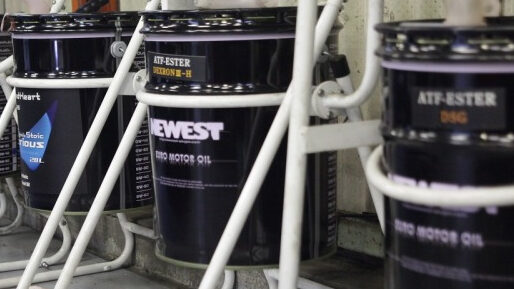
The oil used in the 7-speed dry DSG (DQ200) is specially designed and completely different from regular ATF (automatic transmission oil).
Choosing the wrong oil can cause shifting shock and poor oil pressure.
Here we will introduce the recommended oil specifications and representative brands.
The basic standard is “VW G 052 512 A2”
The VW-specified oil is G 052 512 A2 .
This oil serves both as gear lubrication for the dry DSG and as mechatronic hydraulic fluid
, maintaining an oil film even at high temperatures while being resistant to the absorption of metal wear particles.
It is safest to use genuine oil, but aftermarket oil of equivalent specifications is also acceptable.
The important thing is that the oil is labeled “VW TL 52182” or “G052512A2 compliant.”
Major oil brands
| brand | standard | Features |
|---|---|---|
| Genuine VW DSG oil | G 052 512 A2 | The most reliable. Excellent temperature stability and quietness |
| FUCHS TITAN DSG DCTF | Equivalent standard | Genuine OEM. Good value for money. |
| MOTUL Multi DCTF | Compatible | Resistant to high temperature driving and suitable for sports driving |
| LIQUI MOLY DSG Oil | Compatible | Has a proven track record in European cars in general. High mechatronics protection performance. |
You can scroll
It doesn’t matter which brand you choose, but
avoid “general-purpose DCTF” lubricants that contain additives or have different viscosities.
Differences in viscosity and friction coefficient can affect clutch control.
Genuine or aftermarket? How to choose
- Genuine oil (dealer recommended)
→ Recommended for those who value long-term stability and peace of mind from a warranty. - Aftermarket oil (FUCHS, MOTUL, etc.)
→ Recommended for those looking for cost-effectiveness and improved feel.
Whichever you choose, it’s important not to mix oils from different manufacturers
, as differences in viscosity and additive content can change the hydraulic properties.
Tips
Dry DSGs use a small amount of oil, so the most effective way to keep the inside clean is to change it regularly .
Even if you use genuine oil, performance will definitely decline if you continue to use it for more than 50,000 km.
Changing the right oil early is definitely a better choice for your car than using good oil for a long time.
Overview of the replacement procedure: Workflow explanation to understand how it works
7-speed dry DSG oil change
A unique feature of the 7-speed dry DSG (DQ200)
is that oil changes do not require temperature control like the wet type (DQ250/DQ381).
Because the clutch is not immersed in oil, the most important thing is not the oil temperature, but the amount and tightening accuracy
. Here we will introduce the actual procedures that are performed at the repair shop in an easy-to-understand flow.
① Lift the vehicle up horizontally
Since the oil volume is only around 1.7L,
if the vehicle is tilted, the oil level measurement will be incorrect.
Therefore, the first requirement is to raise the vehicle completely horizontally using a lift
. Jacking up the vehicle on the ground is not recommended due to the tilt and safety concerns.
② Remove the drain bolt and drain the oil.
Remove the drain bolt at the bottom of the transmission and drain out the old oil.
Approximately 1.2 to 1.3 liters will drain.
Checking the color of the oil coming out of the drain and the amount of metal powder
will give you clues as to the state of internal wear.
In this case, a drain washer is not necessary (seal is integrated).
Avoid re-tightening and be sure to retighten securely with a torque of around 45 N m.
③ Filling with new oil (through the upper filling port)
To add oil, remove the fill plug at the back of the black cap
at the top of the engine compartment. From there, use a special hose or a long nozzle to add approximately 1.7 to 1.8 liters
of new oil. The fill port is very narrow, so using a funnel or tube will make it easier.
Adjust the amount of oil to “the amount removed + 0.5 liters” as a guideline.
④ Check for leaks and tightness
After filling, clean the filling port and drain area and check for leaks or seepage .
The aluminum case is soft, so over-torqueing it can damage the threads
. Be sure to use a torque wrench until you get used to it.
⑤ Trial run and final check
After replacing the oil, start the engine and shift the gears in order from P → R → N → D to circulate the oil.
Check for any abnormal noises or shocks during gear changes, and
after a test drive of a few kilometers, check the undercarriage again to complete the process.
This process may seem simple at first glance, but it requires
precision due to the small amount of oil used
. The biggest trick to protecting a dry DSG is to be mindful of not adding too much oil or tightening it too much.
Even repair shops that usually focus on Japanese cars will be able to accept more European cars if they understand the procedures and precautions for servicing
them. If you’re preparing your shop to handle imported cars, check out Yolost, which offers a wide range of maintenance supplies and work environment items
. They stock items that are useful for any manufacturer’s vehicle, including wiring, batteries, and engine oil.
Many of their products are easy to use even for beginners, making them a great first step in DIY maintenance .
Things to be aware of when replacing your DIY: Common mistakes and safety measures
Changing the oil in a 7-speed dry DSG (DQ200) may not seem particularly complicated, but
in reality , precision and safety are extremely important.
If you try it thinking that “less oil = easier,” you may end up with unexpected problems.
Here are some points to keep in mind when considering DIY work.
Jacking is dangerous. Always use a horizontal lift.
The DQ200 has a small amount of oil, so even a slight tilt of the body can throw it off level. It’s
difficult to keep the vehicle level when jacking it up, and the drain is located low, making the job unstable. Ideally, you should use
a two-post lift or pantograph lift from a repair shop
. If you’re doing it yourself, be sure to use sturdy jack stands and
make sure the left and right sides are evenly positioned.
The filling port is narrow, so a special attachment is required
The fill plug located behind the black cap at the top of the engine compartment has a very narrow opening.
It is difficult to insert a regular funnel, so you will need to use
an injection attachment with a narrow hose
(VW-specific or an alternative). Oil is likely to splash out when removing the hose, so
it is a good idea to protect the area with plastic wrap or a towel.
Don’t neglect torque management
Aluminum transmission cases are very soft,
and overtightening can easily strip the threads.
Aim for a torque of around 45 N·m for the drain plug and around 25 N·m for the fill plug. Always use a torque wrench to tighten
, not by feel .
Be careful not to add too much oil
If you add too much oil, foaming and pressure loss can occur while driving,
which can cause gear squeal and hydraulic errors. Keep
the amount of oil you add to the drain approximately 0.5L above the maximum amount, and if you add too much, make fine adjustments from the drain.
Don’t forget to wear safety gear and clean up
Always wear oil-resistant gloves and protective glasses while working, and degrease and clean
the surrounding area with brake cleaner before starting work.
There are many electronic components around the mechatronics area, and if they get oil on them, they may malfunction.
Changing the oil in a dry DSG is not difficult if you follow the procedure.
However, even a single drop of oil or a single torque mismanagement error can cause problems.
If you are unsure, it is best to have the job done at a specialist VW workshop.
Effects and changes in sensation after replacement: What actually happens?
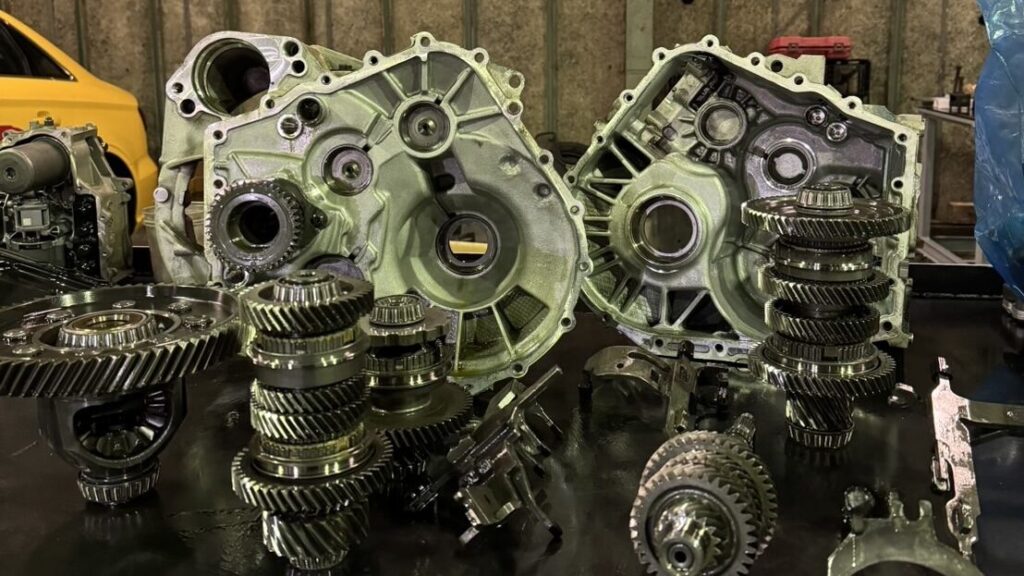
The 7-speed dry DSG (DQ200) is a precision mechanism that uses a small amount of oil to operate the gears and mechatronics simultaneously.
Therefore, there will be a noticeable difference in shifting feel and quietness before and after an oil change .
Here we will introduce the main points of improvement that have been reported frequently at maintenance sites.
Reduced gear shift shock
Deteriorated oil reduces viscosity and causes unstable oil pressure.
As a result, gear engagement may be delayed and a “thud” or shock may occur when shifting gears.
After oil replacement, oil pressure will stabilize and the clutch will shift more smoothly. Shifting
from 2nd to 3rd and 3rd to 4th gears will be particularly natural, and the flow from starting to accelerating will feel lighter.
Reduced gear squeal and noise
If the oil has not been changed for a long time, wear particles and dirt can adhere to the gear teeth,
causing metallic noises and squealing sounds.
By replacing the oil with new oil, lubrication is restored and the friction noise between metal parts is reduced .
You will notice a reduction in noise when in reverse gear or at low speeds.
Stabilization of mechatronic operations
The oil also functions as hydraulic fluid for mechatronic solenoids and accumulators.
New oil has a stable viscosity, which allows hydraulic pressure changes to be transmitted smoothly, resulting in
stable gear selection and shift timing .
This reduces gear hunting and slight sluggishness while riding,
allowing for a more comfortable ride even in urban areas with lots of stop-and-go traffic.
Improved shift feel and positive impact on fuel economy
A major point is that smoother clutch engagement
makes the response when you step on the accelerator more natural,
reducing uneven acceleration and making driving easier
. It also reduces unnecessary spin and shock, which ultimately leads to more stable fuel economy.
An oil change is not just a maintenance, but a “DSG refresh.”
Many owners say that the shifting feel after the oil change is “just like a new car.”
This is the most effective maintenance method for restoring the precise control of the DSG to its original state.
Reference video: Nile Mecha Channel “7-speed dry DSG oil change”
Reference article: 7-speed dry DSG oil change method and precautions – Golf 6C Polo
Estimated replacement cost and cost performance evaluation
The cost of changing the oil for a 7-speed dry DSG (DQ200) is cheaper than for a wet type because there are fewer steps involved .
However, because the oil used is of a special standard and precision in removing and attaching the mechatronics is required,
it does not necessarily mean that “small amount = easy.”
Below are estimates based on the price ranges at actual repair shops.
Average oil change cost (dry 7-speed DQ200)
| Work content | Cost (tax included) | Contents/Notes |
|---|---|---|
| DSG oil change (dry 7-speed) | Approximately 15,000 to 25,000 yen | Oil and labor included (approximately 1.7L replacement) |
| Inspection and diagnosis fees | Approximately 3,000 to 5,000 yen | Mechatronics operation check/leak check |
| Reuse/replace drain bolt | Approximately 1,000 to 2,000 yen | Please check as it is an integrated seal |
| Estimated total | Approximately 18,000 to 30,000 yen | General repair shop or VW specialty store standard |
You can scroll
Comparison with wet DSG (DQ381/DQ250)
| Model | structure | exchange amount | Estimated cost (tax included) | remarks |
|---|---|---|---|---|
| DQ200 (dry 7 speed) | Gear lubricant only | Approximately 1.7L | Approximately 20,000 yen | Easy to replace, clutch non-oil immersion |
| DQ250 (wet 6 speed) | Clutch + gear shared | Approximately 6.5L | Approximately 40,000 to 50,000 yen | Filter replacement available |
| DQ381 (wet 7 speed) | High torque compatible | Approximately 6.5L | Approximately 40,000 to 50,000 yen | Oil temperature control is required |
You can scroll
Dry DSGs have a smaller oil capacity and shorter oil change cycles, so
in some cases the cost per change is lower, but the total cost is the same over the long term.
Tips for keeping costs down
- Have the work done all at once at a trusted VW specialist shop
→ You can save on labor costs by having the work done at the same time as regular inspections and engine oil changes. - Use genuine OEM oil
→ FUCHS and MOTUL VW compatible products are high quality and can reduce costs. - Replace early based on mileage
→ If it is before deterioration progresses, one replacement will be enough to refresh the oil.
The 7-speed dry DSG requires relatively affordable maintenance with replacement costs per change.
The golden rule is to “get it done while it’s cheap,” rather than “put it off because it’s cheap.”
Keeping the oil in good condition will extend the life of the mechatronics and ultimately prevent major repairs.
You can jump to an article that explains the costs and effects of each.
👉 Summary of maintenance and customization costs and work days at VW specialty store Nile Plus
Frequently Asked Questions (FAQ)
Q1. Does the 7-speed DSG (DQ200) really require an oil change?
Yes. Dealers may state that the oil is “maintenance-free,” but
this is based on the assumption that the vehicle will be used within the warranty period (generally around 50,000 km)
. In actual repair work, we have seen that gear noise and shift shock increase after 50,000 to 60,000 km, and
in many cases this can be improved with an oil change.
If you plan to drive the vehicle for a long time, regular oil changes every 40,000 km or so are ideal.
Q2. Can a gear shock be fixed just by changing the oil?
If the shock is minor, it is likely to be improved.
As the hydraulic pressure stabilizes and the solenoid operates smoothly,
the “connection” of the gears will return to normal.
However, if the clutch or mechatronics itself is worn or deteriorated,
a learning reset or part replacement may be necessary.
Q3. Can I change the oil myself?
While structurally it is possible, it requires special tools and a diagnostic machine . Oil volume management is strict, at around 1.7L, and there’s a risk of damaging the aluminum case
due to incorrect filling or overtightening . Since this is a relatively inexpensive maintenance item, we recommend having it done at a VW specialist shop .
Q4. Why don’t I notice any changes after changing the oil?
If the condition is good to begin with or if only a small amount of replacement has been made, you may not notice any noticeable changes.
However, the internal protective performance will be restored, so
it is best to think of this as a replacement to prevent deterioration.
By replacing the filter regularly, you can prevent the accumulation of deterioration and ultimately avoid major repairs.
Q5. Is it necessary to reset the learning after changing the oil?
It is not necessary if it is just a minor replacement, but if there is still shifting shock or
after maintenance that has opened the mechatronics, we recommend resetting it.
By “initializing the clutch learning value” using VCDS, etc.,
it will be easier to return to smoother shifting.
Summary of tips for extending the life of a 7-speed dry DSG
The 7-speed dry DSG (DQ200) is a highly efficient transmission that VW takes pride in.
While structurally simple, the internal mechatronics and hydraulic control are extremely precise. This is why it’s better to think of it as a system that allows you to run for a long time by properly maintaining it
, rather than one that “will run without oil changes .”
Point 1: Make it a habit to change your tires every 40,000 to 50,000 km
Although the manufacturer officially states that replacement is not necessary,
in actual maintenance work, replacement every 40,000 to 50,000 km is the interval that best prevents problems.
Because there is less oil, deterioration occurs quickly, and the accumulation of metal powder can have a negative effect on the solenoid and hydraulic lines.
Simply draining and replacing the oil regularly will greatly contribute to maintaining stable hydraulic pressure and a good shift feel.
Point 2: Accurate oil amount and tightening torque
Adding or removing too much oil, or overtightening the drain, are all bad.
Even the slightest error can cause problems such as pressure loss, foaming, and case cracks.
For DIYers, it is most important to use a torque wrench for accurate control
. If you are unsure, it is best to leave it to a specialist.
Point 3: Don’t overlook gear shift shocks or strange noises
Small changes such as “clicking when shifting gears” or “hesitation in reverse”
are signs of oil deterioration or early malfunctions in the mechatronics.
If you change the oil early, you can prevent the problem from escalating to the point where you need to replace parts. With DSG , early detection and early response are essential
, as the costs of waiting until a malfunction occurs are high .
Summary: Maintenance to protect your DSG
The lifespan of a dry DSG is greatly affected by oil management.
Compared to clutch replacement or mechatronic repair, oil changes are an inexpensive and reliable preventative measure.
Even if you think “I won’t notice a difference if I change it,” it is a field experience that
people who continue to change the oil have fewer problems .
To maintain driving performance and reach the next 100,000 km with peace of mind,
changing the oil in your 7-speed DSG is like giving your car a life-extending drip.
If you can make this a habit, your VW will surely continue to run smoothly until the very end.
Note:
This article is a general explanation of the structure and maintenance of the 7-speed dry DSG (DQ200).
Oil changes require specialized tools and knowledge, so we recommend having them performed by a mechanic or a VW specialist shop.[DSG] A VW specialist will change the oil in your 7-speed dry DSG!
We also recommend these articles:
- Volkswagen Abnormal Noise Diagnostic Guide | Causes, Repair Costs, and Urgency
- Summary of causes of poor running performance | Check points when your car won’t move forward, is unstable, or vibrates
- A comprehensive guide to VW suspension problems, repairs, and maintenance | Basics of bushings, suspension, bearings, and alignment, and symptom-specific checks
▼List of individual articles on DSG repair and maintenance▼
You can scroll
Details of defects by vehicle type
Even if the “way” of the malfunction is similar, “which model has the most common problems” differs slightly depending on the model.
The following page summarizes the trends by model and common malfunction cases among other owners.
You can scroll
This is a guide to keeping your DSG (dual clutch) in good condition for as long as possible.
First, understand how it works, then check out preventative maintenance, then repair options and costs.
👉Nile Mecha Channel Playlist: 7-Speed Dry DSG Mechatronics Special



コメント