


When you turn the steering wheel, “the play is big” and “it reacts with a sudden delay”.
When such anxious symptoms appear, it is very scary to lose a sense of stability at high speeds and curves.
In VW cars, if there is a problem with the steering mechanism, suspension joint, and electric power steering control system, there will be more play and a rattling feeling.
If left unattended, it will not run straight or wobbly, so you need to be careful because it is directly related to driving safety.
In this article, we will explain the causes, neglect risks, DIY checks, and even estimated repair costs.
▼Driving problem diagnosis guide▼
👉Comprehensive summary of causes of poor running
- Common symptoms
- There are four main causes (by structure)
- Cause (1): Wear on the steering rack increases “play”
- Cause (2): Deterioration of tie rod ends/rack ends
- Cause (3): Deterioration of the undercarriage bushing (lower arm stabilizer, etc.)
- Cause (4): Poor control or abnormality of EPS (electric power steering)
- Points that can be checked in DIY
- Is it okay to drive? (Urgency)
- Approximate repair cost
- Related parts to check at the same time
- Conclusion
- Defect details by vehicle type
- Frequently Asked Questions (FAQs)
Common symptoms
- Even if you turn the steering wheel, it feels like the first little bit is empty
- I feel the impact of “squeaking” and “rattling” on the bumps of the road surface.
- Difficult to drive straight, slightly wobbly
- The center of the steering wheel is not stable
- There is no abnormal noise, but only the “play” is getting bigger.
There are four main causes (by structure)
- Wear and rattle of steering gear (rack and pinion)
- Joint deterioration of tie rod ends/rack ends
- Suspension bush arm rattle (undercarriage system)
- EPS (electric power steering) control failure and sensor abnormality
Cause (1): Wear on the steering rack increases “play”
When does it happen?
- Only the initial movement of the steering wheel is unresponsive.
- If you wiggle left and right, there is a delay in the reaction.
- It is easy to get up with a mileage of 8 to 100,000 km or more
Why do I have that symptom?
When the gears (rack and pinion) inside the steering rack wear out, the clearance of the engagement widens and the play increases.
VW’s racks with integrated electric power steering have a heavy load structure and tend to rattle due to wear.
What happens if left unattended?
- Reduced straight-line stability
- Wobble at high speeds
- The entire rack may need to be replaced
Cause (2): Deterioration of tie rod ends/rack ends
When does it happen?
- A small “koto” sound is made on the steps.
- When you turn the steering wheel back, it rattles
- Only one side can be reduced quickly
Why do I have that symptom?
The tie rod end is an important joint that transmits steering wheel operation to the tire.
If the ball joint rattles due to aging, the tire’s response to the steering wheel operation will be delayed, resulting in “shaking” and “wobbling”.
What happens if left unattended?
- Uneven tire wear
- The steering wheel is easier to take
- In the worst case, there is a risk that the joint will fall out (not drivable)
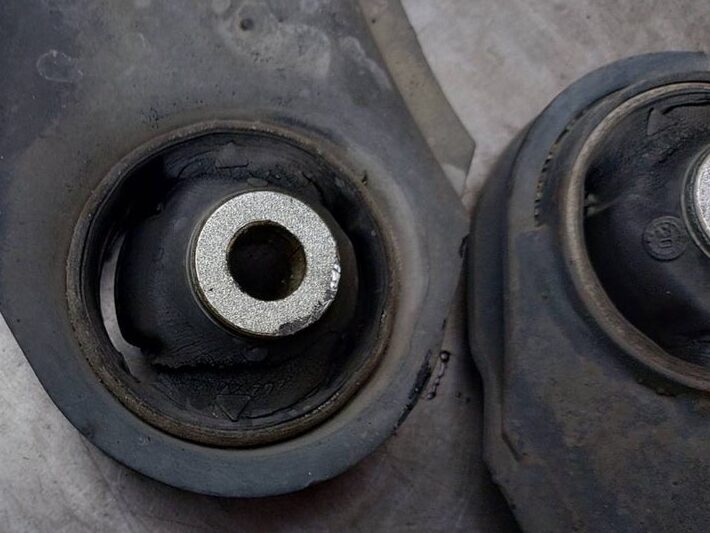
Cause (3): Deterioration of the undercarriage bushing (lower arm stabilizer, etc.)
When does it happen?
- The unevenness of the road surface makes a creaking sound
- Unstable posture during braking
- The reaction force does not return to the steering wheel
Why do I have that symptom?
When the rubber bushings deteriorate, the arms cannot move accurately, and the axis of the suspension is misaligned, making it impossible to transmit steering wheel operation directly.
In particular, the lower arm bushing has a significant impact on driving stability.
What happens if left unattended?
- Straightness becomes worse
- Putting a strain on tires and hubs
- Reduces the life of the entire undercarriage
Cause (4): Poor control or abnormality of EPS (electric power steering)
When does it happen?
- The steering wheel is too light or suddenly becomes heavy
- Unstable sensitivity near the center
- EPC / Steering warning light may also be on
Why do I have that symptom?
EPS detects input with sensors and assists with motors.
If there is a sensor abnormality or a defect in the internal board, the assist may not work as intended, causing play and discomfort.
What happens if left unattended?
- The handle becomes heavier
- Driving safety is reduced due to disturbed control
- In some cases, it may be necessary to replace the rack assy
Points that can be checked in DIY
- At low speed, wiggle the steering wheel left and right to check for delays in reaction
- Shake the tire left and right to check the rattle of the joint (when jacking up)
- Whether there is abnormal noise on the bumps of the road surface
- Presence or absence of EPS warning light
- Is there uneven tire wear?
*To ensure safety, be careful not to work in an unreasonable position or jack up. The final decision is to go to the maintenance shop.
Is it okay to drive? (Urgency)
- Can be run for a while: mild bush straining
- Risk of worsening symptoms: Initial rattling of tie rod ends and poor EPS control
- Driving NG (towing recommended): Large rattle of the steering rack, joint on the verge of damage
When a driving problem occurs, it may be necessary to tow the truck depending on the situation.
In these cases, it may be covered by road assistance or riders of automobile insurance, so it is safe to lightly review the contents of your current contract.
If you may not have a proper understanding of the coverage, you can use a comparison service to check the coverage details and premiums of multiple companies at once. Since you can get a complete picture in a short time, many people use it for repairs and inspections.
👉 Free Car Insurance Bulk Quote Service
Approximate repair cost
| Work Description | Approximate cost |
|---|---|
| Tie Rod End Replacement | 15,000 to 30,000 yen |
| Lower Arm Bushing Replacement | 20,000 to 45,000 yen |
| Stabilize link replacement | 10,000 to 20,000 yen |
| Steering rack replacement | 120,000 to 200,000 yen |
| EPS diagnosis and adjustment | 5,000 to 15,000 yen |
| Alignment Adjustment | 10,000 to 18,000 yen |
| Diagnosis fee | 5,000 to 10,000 yen |
You can scroll
*If it is an initial discovery, you only need to replace the parts, and as a result, the repair cost can be reduced.
👉Summary of maintenance and custom costs & working days of VW specialty store Nile Plus
Related parts to check at the same time
- Tie Rod (Rack End)
- Lower Arm Bushing
- Stabilize Link
- Hub Bearings
- Drive Shaft
- EPS Sensor/Angle Sensor
- Alignment Figures
▼List of individual pages about undercarriage repair and maintenance▼
Conclusion
If you feel play or rattle in the steering, the main causes are rack wear, joint deterioration, undercarriage bushing, and poor EPS control.
If left unattended, it will reduce straight-line stability, which can be dangerous at high speeds and in curves.
Early inspection can reduce the minimum necessary parts replacement, so if you feel uncomfortable, we recommend that you inspect it at a maintenance shop as soon as possible.
Even if the symptoms are similar, the causes vary from vehicle to vehicle.
Even if there are similar abnormal noises and malfunctions, there are various causes such as turbo belts and sensors.
If you are unsure, it is safe to have it inspected at a maintenance shop without overdoing it.
Defect details by vehicle type
Although the “way of getting out” the defect is similar, “which model has many problems” is slightly different for each car model.
Trends by vehicle model and common breakdown cases among other owners are summarized on the following page.
Frequently Asked Questions (FAQs)
Q1. How long is the normal “play” of steering?
A1. There is a slight play depending on the car model, but it is not normal when you clearly feel a delay when operating, or if there is a “thud” on a step. If you feel even a little discomfort, we recommend checking it.
Q2. Is it okay to continue running with increased play?
A2. If it is an early symptom, it is possible to drive, but it can lead to serious problems such as missing joints and worsening rack wear. It is safe to avoid highways and long distances and inspect early.
Q3. Can the wobbly handle be fixed just by adjusting the alignment?
A3. Alignment may be the cause, but if there is a rattle in the tie rod end or bushing, adjustment alone will not improve it. It is important to identify the cause and replace the necessary parts.
Q4. What are the key points that can be judged by DIY?
A4. These include delays during wiggle steering operations at low speeds, joint rattling due to tire shaking from side to side, uneven wear, and the presence or absence of EPS warning lights. However, the final decision must be confirmed at the maintenance shop.
Q5. I am worried about the high repair cost. Where should I start?
A5. It is recommended to get a diagnosis first. Depending on the cause, only a small part replacement may be required. A mechanic who is familiar with VW will be able to make minimal suggestions that avoid unnecessary work.



コメント