




I think I’m driving straight, but the car wobbles slightly or the steering …… restless.
If you have such a sense of incongruity, you may be worried that something is broken.
In VW vehicles, when the rubber bushings around the undercarriage, such as the lower arm bush and stabilizer bush, deteriorate, straight-line stability is greatly reduced.
Not only mileage and age, but also step impact and parking lot turnover will gradually deteriorate.
In this article, we will explain in an easy-to-understand manner how symptoms appear, causes, how to identify them with DIY, and repair costs.
▼Driving problem diagnosis guide▼
👉Comprehensive summary of causes of poor running
- Summary of common symptoms
- There are three main causes (by structure)
- Cause (1): The car flows due to deterioration of the lower arm bushing
- Cause (2): Deterioration of the stabilizer link and stabilizer bush
- Cause (3): Bush deterioration of suspension arms
- Points that can be checked in DIY
- Is it okay to drive? (Urgency)
- Approximate repair cost
- Related parts to check at the same time
- Conclusion
- What to read next
- Defect details by vehicle type
- Frequently Asked Questions (FAQs)




Summary of common symptoms
- I run straight but I don’t get it
- The steering wheel is restless and unstable near the center
- Easy to get caught in ruts on the road surface
- There is a “koto” and “squeak” sound on the steps
- Unstable posture when braking
- Tires tend to lose
There are three main causes (by structure)
- Cracks and sagging of the lower arm bush (the most common cause of loss of straightness)
- Stabilizer link and stabilizer bush rattling (unable to control left and right shaking)
- Bush deterioration of suspension arms (camber toe is not stable)
Cause (1): The car flows due to deterioration of the lower arm bushing
When does it happen?
- Be sensitive to ruts
- Slightly wobbly from side to side at high speed
- Handle input is transmitted with a delay
Why do I have that symptom?
The lower arm bush is a “big fulcrum” that connects the suspension and the body.
If this deteriorates, the lower arm will not move on the correct axis, and the tire angle (toe angle) will easily shift when driving straight.
VW cars have a delicate undercarriage, and the condition of the lower arm bushing greatly affects driving stability.
What happens if left unattended?
- Straight-line stability is greatly reduced
- Uneven wear progresses
- If the bush is completely cut off, safety is greatly impaired
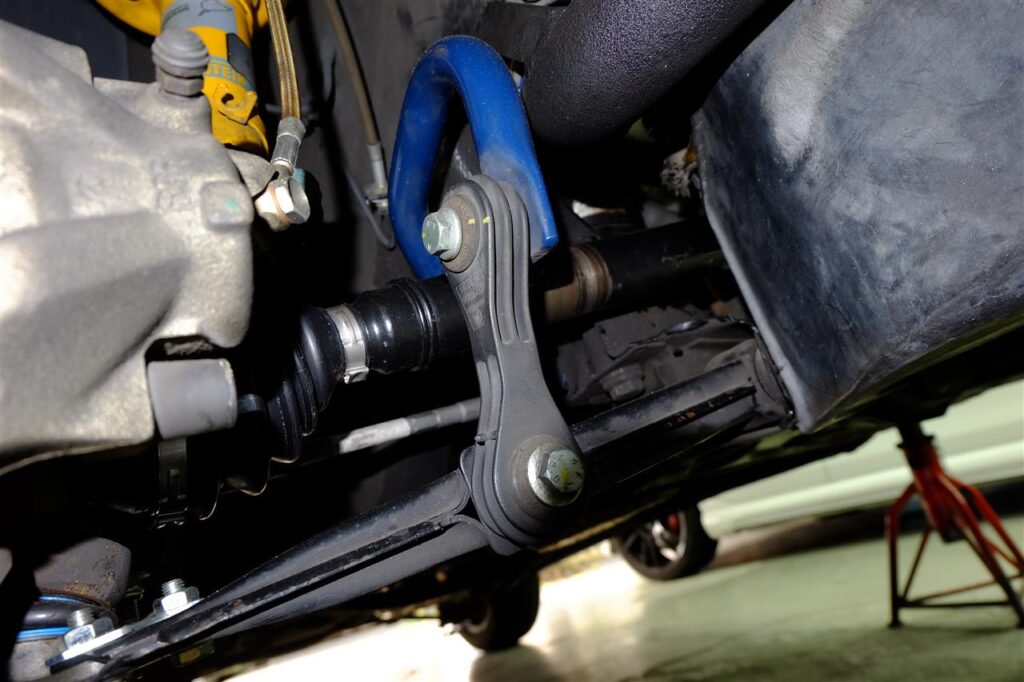
Cause (2): Deterioration of the stabilizer link and stabilizer bush
When does it happen?
- Clattering and creaking sounds on steps
- The left and right shaking does not fit well
- Fluffy behavior in curves and mergers
Why do I have that symptom?
The stabilizer is a device that connects the left and right suspensions to suppress the roll of the car body.
When the stabilizer bush deteriorates, the roll becomes larger and it is easy to wobble when driving straight.
The rattling of the links also causes steering delays and shaking.
What happens if left unattended?
- The suspension is always fluttering
- Stability becomes worse and driving at high speeds becomes scary
- Other arms are also burdened
Cause (3): Bush deterioration of suspension arms
When does it happen?
- Unnatural curves
- The steering wheel runs amok on rough road surfaces
- Tire depletion speeds up
Why do I have that symptom?
The bushing is responsible for absorbing and coordinating the movement of each arm.
When deteriorated, the axis of the arm becomes blurred, the camber angle and toe angle are not stable, and the posture when driving straight is disturbed.
VW cars have a complex arm structure, and a single bushing defect can affect the whole.
What happens if left unattended?
- Alignment is always unstable
- Burden on tires, hubs, and bearings
- Shorter life of the undercarriage
Points that can be checked in DIY
- Will you slowly cross the steps and make a “squeaking sound”?
- Tire fragmentation (inside only/outside only)
- Cracks and deformations of the lower arm bushing (*if visible)
- Is the steering center stable?
- Is there a strong wobble on a road with ruts?
*Do not overdo it because jack-up work is dangerous. For detailed inspections, go to the maintenance shop.
Is it okay to drive? (Urgency)
- Can be driven for a while: mild stabilizer bush deterioration
- Risk of worsening symptoms: cracks or partial sagging of the lower arm bush
- Driving NG (towing recommended): The bush is completely cut off, the arm is too loose
When a driving problem occurs, it may be necessary to tow the truck depending on the situation.
In these cases, it may be covered by road assistance or riders of automobile insurance, so it is safe to lightly review the contents of your current contract.
If you may not have a proper understanding of the coverage, you can use a comparison service to check the coverage details and premiums of multiple companies at once. Since you can get a complete picture in a short time, many people use it for repairs and inspections.
👉 Free Car Insurance Bulk Quote Service
Approximate repair cost
| Work Description | Approximate cost |
|---|---|
| Lower Arm Bushing Replacement | 20,000 to 45,000 yen |
| Stabilize link replacement | 10,000 to 20,000 yen |
| Stabilize Bush Replacement | 8,000 to 18,000 yen |
| Suspension Arm Replacement | 25,000 to 60,000 yen |
| Alignment Adjustment | 10,000 to 18,000 yen |
| Diagnosis fee | 5,000 to 10,000 yen |
You can scroll
*The sooner the bush is replaced, the lower the cost.
👉Summary of maintenance and custom costs & working days of VW specialty store Nile Plus
Related parts to check at the same time
- Tie Rod Ends
- Hub Bearings
- Lower Arm Ball Joint
- Stabilize Link
- Alignment angle (especially toe angle)
- Suspension mounts
▼List of individual pages about undercarriage repair and maintenance▼
Conclusion
The cause of unstable straight driving is often the deterioration of the undercarriage bushing, such as the lower arm bushing and stabilizer bushing.
If the rubber weakens due to age or driving impact, the movement of the arm will be disturbed, and the tire angle will not be stable and wobbly.
If left unattended, it can lead to uneven wear and reduced driving stability, so it is safe to inspect and replace it as soon as possible.
Even if the symptoms are similar, the causes vary from vehicle to vehicle.
Even if there are similar abnormal noises and malfunctions, there are various causes such as turbo belts and sensors.
What to read next
Please proceed to the article below that best describes your symptoms.
- Steering Wheel Jerks on Bumps? How to Diagnose Undercarriage Rattles and Play
- Steering Wheel Flutter at High Speed: Causes and Loss of Straight-Line Stability
- Steering Wheel Pulls to One Side: Alignment vs Tire Issues and How to Tell
- Car Pulled by Road Surface Bumps? Causes of Tramlining in VW and How to Fix It
- Why Won’t My Car Drive Straight and Why Is It Making Noise? Common Causes Explained
- Causes of increased steering play|If you feel “rattling” on the steering wheel
- Why Doesn’t My Car Track Straight After New Tires? Alignment and Setup Issues Explained
- Car Won’t Track Straight? Symptoms of Worn Undercarriage Bushings and How to Tell
- Why Doesn’t EPS Correct Steering? Straight-Line Instability in VW Without a Warning Light
- Car Feels Floaty or Unstable? Causes of Suspension Failure and Shock Wear Symptoms
Defect details by vehicle type
Although the “way of getting out” the defect is similar, “which model has many problems” is slightly different for each car model.
Trends by vehicle model and common breakdown cases among other owners are summarized on the following page.
Frequently Asked Questions (FAQs)
Q1: Why does the lower arm bushing not run straight when it deteriorates?
The lower arm bushing is the fulcrum of the suspension, and if it is weak, the arm will not move on the correct axis and the toe angle will not be stable. As a result, it is easier for the car to flow from side to side while driving straight.
Q2: How can I tell the difference between the deterioration of a stabilizer bush and a lower arm bushing?
If the “squeaking sound” on the steps or the size of the roll is noticeable, it is likely to be a stabilizer. If swaying or rut sensitivity is noticeable when driving straight, the lower arm bush is suspected.
Q3: Even if the bush is deteriorated, is it okay to run it for a while?
If it is mildly deteriorated, it is possible to drive, but if it worsens, the straightness will be greatly reduced, leading to uneven wear and arm rattling. If there are cracks or breaks, it is not allowed to drive.
Q4: Can I check the condition of the bushing with DIY?
Cracks and deformations may be visible visually. There is also a way to slowly cross the bump to reproduce the sound and check for tire debris. However, it is safe to make the final decision at a maintenance shop.
Q5: Is bushing replacement and alignment adjustment required as a set?
In many cases, it is necessary. Since the arm position changes after the bushing is replaced, the toe angle and camber angle are prone to misalignment, and alignment adjustment is recommended to achieve accurate straightness.



コメント