




Navigation
The Volkswagen Golf 6 Cabriolet is a rare model that combines the practicality of previous Golf models with the open feeling of an open-top model.
This generation, produced mainly in 2012, has been highly praised for its nimble performance, combined with a 1.4L TSI engine and 7-speed DSG, as well as its design that combines quietness and rigidity.
This article will look at the Golf6 Cabriolet’s structural features, the mechanism of its electric soft top, interior equipment, suspension configuration, and other aspects from a technical perspective.
It will also delve into the appeal of this model from a practical perspective, including maintenance, while touching on specific maintenance points and areas that have been improved in later models.
YouTube reference link: “Golf6 Cabriolet Vehicle Introduction and Maintenance Overview”
▼ Nile Plus service details ▼
Visit the official Nile Plus website
▼Nile Mecha Channel Technical Article Navigation▼
DSG Special Feature
Suspension Special Feature
Engine Special Feature
👉Check out Nile Mecha Channel (youtube)
Also Recommended
- VW specialty store reveals the reality of vehicle inspection costs
- How to determine labor costs for car maintenance
- Is it okay to bring parts to a repair shop?
- How to identify an accident car
- How to identify flooded vehicles
- Vehicle overview and basic specifications
- Powertrain and driving performance
- Body structure and soft top mechanism
- Interior and amenities
- Chassis and suspension configuration
- Electrical and safety equipment
- Important points to note regarding maintenance and long-term use
- The modern values of the Golf 6 Cabriolet
- Summary – The Balance Between Technology and Design
- Frequently Asked Questions (FAQ)




Vehicle overview and basic specifications

Model, year, and powertrain configuration
The Golf 6 Cabriolet is an open-top Volkswagen model produced from 2011 to 2016.
Models include the “1KCAV” and feature a 1.4L inline 4-cylinder TSI engine mated to a 7-speed dry DSG (dual-clutch transmission).
This 1.4TSI is a “twin-charger” model that combines a supercharger and turbocharger, and despite its small displacement, it has acceleration performance comparable to that of a 2.0L class car.
Basic specifications such as overall length, overall width, and vehicle weight
With a length of 4,270mm, width of 1,780mm, and height of 1,430mm, it is slightly lower than the Golf6 of the same era.
It weighs around 1,500kg, which is light for a convertible with an electric roof.
Weight distribution is well balanced at roughly 60:40 front to rear, and it is characterized by little change in stability when the roof is open or closed.
Thanks to body reinforcement and soundproofing, it combines a high level of rigidity and quietness even when the roof is open.
Platform: Features of the pre-MQB design of the 6th generation Golf
The Golf6 Cabriolet is based on the PQ35 platform, which was introduced before the introduction of MQB (Modular Structure).
This design is a framework that has been refined since the Golf5, and is characterized by a simple and robust structure with front struts and a rear torsion beam.
It is easy to ensure rigidity, and the suspension is also easy to maintain.
It feels a little heavier than the latest MQB cars, but the driving feel, which gives it a “metallic texture,” is what makes it so appealing.
Domestic distribution volume and rarity
Only a limited number of Golf 6 Cabriolet cars have been officially imported into Japan.
Late models in particular are scarce, and cars in good condition are popular on the used market.
Even now, several years after production ended, it remains a popular compact, easy-to-handle convertible, offering a “mechanical character” that is rare in modern cars.
- Volkswagen’s common breakdowns and repair costs
- A complete guide to maintenance costs, breakdown risks, and how to choose a VW Golf for those considering buying or leasing
- How to drive a new Volkswagen Golf “smartly” | Aging costs and car leasing
- Volkswagen specialty store Nile Plus car sales – from purchasing to delivery
- Golf7 GTI Performance Intake Tuning – Intake Installation
Powertrain and driving performance
1.4L TSI engine structure and features
The 1.4L TSI engine installed in the Golf 6 Cabriolet is a “twin-charger” system that combines a supercharger and turbocharger in series.
At low RPMs, the supercharger instantly starts boosting, and at mid- to high RPMs, the turbocharger takes over, achieving powerful acceleration that you wouldn’t expect from a 1.4L engine.
Maximum output is around 160 PS and maximum torque is 24.5 kgm.
It is easy to handle in the city and provides a powerful feel even at highway speeds.
Dry 7-speed DSG mechanism and improvements
The transmission that comes with it is a 7-speed dry DSG called “DQ200.”
It alternates between two clutches and has a structure that waits for the next gear in advance, allowing for smooth and quick gear changes.
While it is lighter and more efficient than a wet type, it also has the issue of being susceptible to heat.
For this reason, improvements have been made to cooling performance and optimization of software control, and reliability has been greatly improved in later models.
DSG oil management that should be taken into consideration during maintenance
In a dry DSG, the clutch itself is not lubricated with oil, but a special fluid is used for the mechatronics (hydraulic control unit).
Regularly changing this fluid can prevent problems such as shift shock and gear slippage.
Ideally, the oil should be replaced with the original oil (such as G 004 000 M2) every 40,000 to 50,000 km.
To ensure a long and comfortable ride, it’s important to maintain good DSG heat management and hydraulic system condition.
Feeling characteristics when driving around town/highway
In city driving, the engine has ample torque from around 1,500 rpm, allowing for smooth acceleration with just a light touch on the accelerator.
It also shifts gears quickly, making it ideal for fuel-efficient driving.
On the highway, the engine speed remains around 2,500 rpm even at speeds approaching 120 km/h, achieving both quietness and stability.
With the supercharger providing response and the turbo providing power extension, the engine delivers stress-free acceleration across the entire engine speed range.
This powertrain achieves an ideal balance for a compact convertible.
Body structure and soft top mechanism
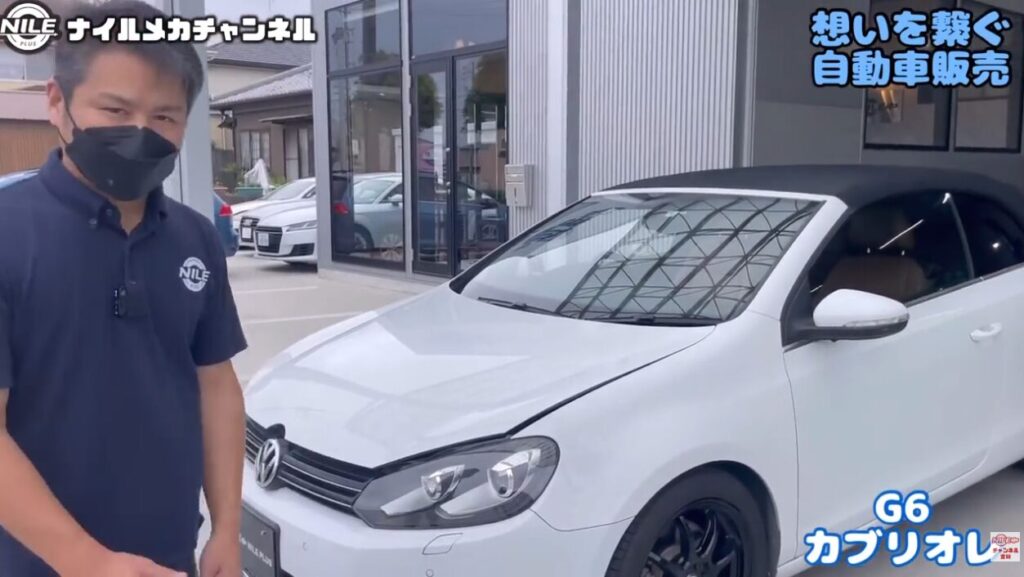
Operating principle of roof opening and closing system
The Golf 6 Cabriolet’s greatest feature is its electro-hydraulic soft top.
When the lock at the top of the A-pillar is released, the hydraulic pump is activated and the roof is stored in the trunk in about 10 seconds.
Opening and closing is completed with a single switch, and it can be operated while driving at speeds up to 30 km/h.
The hydraulic cylinder and link arm work together to smoothly store the roof while avoiding the trunk opening, and the design is very sophisticated, and it is notable for its quiet operation even after years of use.
Hydraulic motor and linkage maintenance points
A hydraulic motor and several cylinders are involved in the operation of a soft top.
It is important to regularly check the hydraulic oil level and check for oil leaks and hose deterioration.
If the opening and closing speed seems slow, this may be due to dirt inside the motor or a drop in oil pressure.
Grease the linkages to prevent abnormal noise and jerky movement.
Annual operation inspections and hydraulic fluid changes every 3 to 5 years will ensure stable operation for a long period of time.
Trunk layout with roof stowed and effect of wind deflector
When the roof is open, a storage cover drops down over the top of the trunk, slightly limiting the loading space, but there is still enough capacity for everyday use.
By installing a wind deflector, the wind blowing in while driving can be significantly reduced, and comfort is greatly improved when the rear seats are not in use. It
makes it easy to have a conversation even when driving at high speeds, and is effective in preventing the “wind fatigue” that is unique to open-top cars.
Regarding the structure of the rear glass adhesive
In early soft-top vehicles, there were cases where the adhesive between the rear glass and the canvas would separate.
However, the Golf6 Cabriolet has improved durability through improvements to the adhesive and revised internal reinforcement.
Regularly cleaning the roof and avoiding strong water pressure when washing the car will help prolong the life of the adhesive.
Storing the car indoors and using a body cover are also effective ways to prevent UV degradation.
Interior and amenities
Tan leather seat material, aging and maintenance methods
The Golf 6 Cabriolet’s signature feature is its high-quality tan-colored leather seats.
Made from soft, genuine leather, they offer a moist texture and a distinctive scent when new.
Over time, the leather will develop a richer luster and wrinkles will create a natural texture, but to prevent it from drying out or hardening due to UV rays, it’s important to regularly care for it with a special cleaner and moisturizing cream.
If you plan to park your car in direct sunlight for long periods of time, using a sunshade will help prevent deterioration.
Comfortable seat heater and steering system design
The front seats come standard with three-level adjustable heated seats, making them comfortable even in winter or at night.
The steering wheel is wrapped in genuine leather for a firm grip, and the electric power steering provides a light and responsive feel.
The short wheelbase and high body rigidity ensure a natural response to steering inputs, making the car easy to maneuver around town.
One of the appealing features of this model is the sense of unity between the driver and the car.
Wiring configuration when equipped with genuine navigation system/aftermarket navigation system (DIATONE)
The factory navigation system (RNS315) shares vehicle information via CAN communication.
Therefore, if you are replacing it with an aftermarket navigation system, you will need to purchase a dedicated CAN conversion harness.
Even if you install a DIATONE or Carrozzeria navigation system, you can maintain the steering wheel switches and vehicle setting menu.
Video signals from backup cameras and drive recorders are generally connected via RCA, and stable image quality can be achieved by inserting a noise filter.
Parking assist monitor and rear camera signal processing and implementation example
The factory option rearview camera is directly connected to the RNS315, and guidelines are automatically displayed.
If an aftermarket navigation system is installed, a conversion adapter is required to capture the video signal. While
the camera’s power is typically derived from the reverse signal, failure to properly route the wiring can result in noise entering the CAN communication line.
Installation by a specialist shop or using a power isolation circuit is recommended.
Overall, the interior configuration strikes a good balance between visibility and safety.
Chassis and suspension configuration
Golf 6-based front strut/rear torsion beam structure
The Golf6 Cabriolet uses the base Golf6 platform (PQ35) and is configured with a MacPherson strut front suspension and a torsion beam rear suspension.
This combination is lightweight and rigid, providing an excellent balance between cost and stability.
Reinforcements have been added specifically for the Cabriolet to increase the rigidity of the rear floor, making it less likely to feel twisting even with the top down.
The ride is a little stiff, but the steering response is good, resulting in a suspension system that gives a sense of security.
Change in center of gravity and effect on ride quality due to lowering springs (Eibach)
A standard customization chosen by many owners is the installation of Eibach lowering springs.
This lowers the vehicle by approximately 20 to 25 mm compared to the factory setting, stabilizing the center of gravity and reducing roll when cornering.
On the other hand, there is a tendency for the vehicle to be slightly more jostled over bumps, but comfort can be maintained by adjusting the tire pressure and shock absorber damping.
The appeal of this customization is that it combines stylish looks with handling stability.
Factory alignment settings and adjustment guidelines after changing vehicle height
In the stock state, the front wheels have a slight toe-in on the inside, and the camber angle is set at around -0.5 degrees.
When lowering springs are installed, the camber increases in the negative direction, and the toe angle also changes slightly.
Leaving this in place can lead to uneven tire wear and reduced straight-line stability, so it is essential to readjust the alignment after lowering.
If you mainly drive around town, use the stock values as a base, but if you prioritize sporty driving, you can achieve a good balance by setting the front wheel camber a little stronger (around -1.0 degrees).
Selection points for 17-inch WORK wheels
When fitting 17-inch wheels to a Golf 6 Cabriolet, it’s important to carefully select the offset and rim width based on the original 205/45R17 size.
WORK wheels are lightweight, highly rigid, and offer an excellent dress-up effect.
An offset of around +45 is appropriate, and there are no issues with fender clearance.
Popular tires include Michelin Primacy 4 and Continental Premium Contact, which offer an excellent balance of quietness and grip .
Simply changing the wheels can give the car a more refined ride.
Electrical and safety equipment
ETC, drive recorder, and additional electrical equipment installation diagram
The Golf 6 Cabriolet’s factory electrical system is relatively simple, making it easy to install additional equipment.
ETCs are often installed in the passenger glove box or center console, and draw power from the ACC (accessory power).
When installing a dashcam, it is safe to use an empty terminal in the fuse box.
When installing a front and rear camera type, it is important to route the wiring away from the range of movement of the roof opening and closing mechanism.
LED taillights reduce power consumption and improve visibility
The Golf 6 Cabriolet comes equipped with factory LED taillights, which provide bright light while reducing power consumption. They
offer fast response when lit and are designed to be safe brake lights.
If some of the LEDs stop working due to aging, the basic rule is to replace the entire unit, but in addition to new genuine parts, OEM parts are also available.
When considering replacing with aftermarket LED bulbs, choosing parts that are designed to prevent CAN bus errors will help prevent the warning lights from illuminating incorrectly.
Important points to note when linking monitors and navigation systems using CAN communication
The Golf’s 6th generation electrical system connects each control unit via CAN (Controller Area Network) communication.
Therefore, when replacing the navigation system or monitor with an aftermarket product, it is necessary to convert the CAN signals.
Using a dedicated CAN adapter allows you to maintain steering remote control operation, reverse signals, vehicle speed pulses, and other functions.
However, using a low-quality conversion harness can result in noise interference and malfunctions, so it is best to choose a product from a trusted brand.
Balancing safety and comfort
The Golf 6 Cabriolet was equipped with many advanced safety features for its time.
In addition to ESP (Electronic Stability Program), four-wheel disc brakes, and multiple airbags, it also came standard with a rollover protection system.
In the event of a rollover, roll bars would automatically deploy from behind the rear seats to protect occupants.
It also featured automatic headlights with light sensors and rain-sensing wipers, achieving both comfort and safety.
Despite its compact size, this model’s appeal lies in its electrical equipment quality, which rivals that of luxury cars.
Important points to note regarding maintenance and long-term use
Checking the operation of the soft top mechanism and lubrication maintenance cycle
The Golf 6 Cabriolet’s soft top is operated by hydraulics and a link mechanism, so regular operation checks and lubrication maintenance are essential.
It’s a good idea to open and close it once a month to prevent air from getting trapped in the hydraulic lines and the links from becoming stiff.
Apply a thin layer of silicone grease to the joints to prevent sticking due to dust or moisture.
If you notice a decrease in opening and closing speed or unusual noises, check the hydraulic motor’s oil level and have it serviced promptly to prevent problems.
Importance of DSG engine oil change cycle
This model is equipped with a 1.4 TSI engine and a 7-speed DSG, and oil management has a major impact on the vehicle’s lifespan.
Ideally, engine oil should be changed every 10,000 km or one year, while the DSG mechatronics fluid is recommended to be changed every 40,000 to 50,000 km.
While dry DSGs do not use oil in the clutch itself, deterioration of the hydraulic fluid that supports the operation of the internal solenoid can lead to shift shock and the illumination of warning lights.
By using the specified genuine oil and thoroughly changing it regularly, you can maintain smooth shifting performance for a long time.
- DSG oil change | An easy-to-understand explanation of change timing and effects
- Cost and effectiveness of 7-speed wet DSG oil change
- Does a 7-speed dry DSG require no oil changes?
- Explaining the necessity of changing the oil in a 6-speed wet DSG while working
Recommended rust prevention and undercarriage protection treatment
The Golf 6 Cabriolet is equipped with many reinforcing parts to increase body rigidity, so rust prevention measures for the undercarriage are important in winter and in areas with sea breezes. The rust-preventive
paint on a new car is relatively strong, but the paint film thins over time, so regular undercoating is effective. We
recommend applying an anti-rust spray to the center of the floor, the underside of the side sills, and the suspension arms in particular.
Also, checking for clogged drain holes and ensuring water drainage will help prevent rust from progressing.
Relationship between battery voltage and roof operation stability
When opening or closing the soft top, a large current flows through the hydraulic pump and control unit, so the battery condition has a significant impact on roof operation.
If the voltage drops below 12V, opening or closing may stop midway or an error may occur.
When replacing the battery, choosing a large-capacity AGM type will provide greater stability and allow for more room for adjusting the airflow when driving with the top down and for electrical loads.
Regular voltage checks and maintaining a constant charge are key to enjoying a comfortable open-top life.
Related articles
- How to tell if a car has been repaired | Read the sheet metal marks, structural distortion, and substitute parts
- How to identify a damaged car : Check for bolt marks, paint, and caulking
- How to tell if a car is flooded | Borderlines for interior and engine
- Car sales that connect the hearts of people | A circular car lifestyle that passes cars from private purchases to the next owner
The modern values of the Golf 6 Cabriolet
The background behind achieving a sense of rigidity comparable to that of a closed body
The Golf 6 Cabriolet is renowned for its high body rigidity, despite being an open-top car.
Even with the roof removed, twisting is minimized through carefully designed reinforcements, such as floor reinforcement, increased strength of the A-pillars, and internal stiffening of the side sills.
This reduces the “flex” that is common in ordinary convertibles, achieving a sense of stability closer to that of a closed body.
This gives the car a firm driving feel even with the top down, achieving both sportiness and a sense of quality.
Maintenance and parts supply status after discontinuation
Even though production has ended many years ago, the Golf6 Cabriolet remains a relatively easy model to maintain.
Many of the engines and chassis share parts with the Golf6/Scirocco, so major consumables are still available.
Meanwhile, the availability of genuine new soft-top hydraulic units and interior trim is declining, making it more practical to purchase rebuilt parts or parts sourced overseas.
Specialized shops often stock repair parts and countermeasures, so if you’re planning on maintaining your car for the long term, it’s a good idea to secure a reliable maintenance center early on.
Position in the used market and cost performance
In the used market, the Golf 6 Cabriolet is popular as a “practical open-top car.”
Most of the cars have mileage of around 50,000 to 70,000 km, and even in good condition, prices are relatively stable, and maintenance costs are easy to keep low, which is an appealing feature.
The high-quality materials and assembly precision of the new car are still in place, and with proper maintenance, it can maintain comfort that is not inferior to that of a later model car.
It offers a high level of satisfaction for the price, making it an extremely cost-effective car for those who want to combine leisure and practicality.
Perfection as a compact cabriolet
With a body size of less than 4.3m in length and stable handling characteristics, the Golf6 Cabriolet is a rare car that combines easy maneuverability with high-speed stability.
Although it lacks the digital controls of the latest models, it is a rare vehicle that offers the joy of driving and a sense of mechanical unity.
Compared to modern cars with an increasing number of electronic controls, the driver’s operations feel directly reflected in the car’s movements, making it an extremely well-rounded open-top car that lets you experience the joy of driving.
If you want to choose a high-quality VW with peace of mind
Nile Plus, a VW specialty store, handles carefully selected high-quality vehicles from all over the country, based on the policy of “only stocking Volkswagens that we would truly want to drive.”
From purchasing to delivery, all processes are handled responsibly by former VW dealer mechanics.
With inspections using dedicated testers, over 71 pre-delivery maintenance items, and a one-year warranty,
we offer the same peace of mind as domestically produced cars.
Can you find a car model that is not in stock?
Of course it is possible.
We utilize our nationwide network to sell made-to-order vehicles, allowing you to specify the exact grade and color you desire. We
will use our professional eyes to find and deliver your ideal vehicle.
👉Volkswagen specialty store Nile Plus car sales – see everything from purchasing to delivery
▼ Nile Plus service details ▼
Visit the official Nile Plus website
Summary – The Balance Between Technology and Design
The Golf 6 Cabriolet is a highly refined open-top model that is typical of Volkswagen, combining sportiness and high quality.
The combination of a 1.4 TSI engine and a 7-speed DSG delivers nimble driving and low fuel consumption, making it a natural fit for everyday use.
It is particularly noteworthy that despite being an open-top car, it has high body rigidity, providing a sense of stability that is no less than that of a closed body.
The high level of structural perfection and ease of maintenance elevate this car to the level of an “import car that can be enjoyed for a long time.”
In terms of design, the straight-line form unique to the 6th generation Golf is in perfect harmony with the classic texture of the soft top.
Even with the roof closed, it has a natural coupe line, and the moment you open it, it exudes the charm of a light and nimble convertible. The
tan leather and high-quality interior will never feel outdated even after many years, and it’s a space you’ll grow to love more and more with each ride.
Another appealing feature of this model is its ease of use in everyday life.
It is practical for four people and has ample luggage space for an open-top car.
The soft top can be opened and closed in a short time, making it easy to deal with sudden rain.
Maintenance costs are relatively low, and as long as you maintain it regularly, it is suitable for long-term ownership.
The Golf 6 Cabriolet is a car that prioritizes “perfection as a tool” over flashy presentation.
This model does not rely on excessive electronic controls, but rather allows you to feel the mechanical response and joy of driving, making it even more valuable in this modern age.
With proper maintenance, its appeal will deepen and you will be able to enjoy a comfortable open-top life forever.
[Car sales that connects thoughts] Introducing the 2012 Golf 6 Cabriolet!

Frequently Asked Questions (FAQ)
Q1. How often should I inspect my soft top?
Ideally, it’s recommended to check the operation and check for oil leaks around the cylinder once a year, separate from your vehicle inspection.
Opening and closing the valve once or twice a month, which also serves to bleed air from the hydraulic line, will help maintain good condition.
Grease the valve once a year, and apply a thin layer of silicone-based protective agent to the rubber seals to prevent deterioration.
Q2. I hear there are a lot of problems with DSGs, but what is the reality?
The dry 7-speed DSG (DQ200) has been the subject of much discussion due to initial issues, but the Golf 6 Cabriolet is equipped with an improved specification that can be used reliably with proper oil management.
Changing the oil every 30,000 to 40,000 km and avoiding prolonged half-clutch operation while in traffic jams can significantly extend its lifespan.
Even if the warning light comes on, mechatronics repair can often resolve the issue.
Q3. If the hood fabric gets dirty, how should I care for it?
For fabric soft tops, use a special cleaner and gently remove dirt with a soft brush.
Avoid using a high-pressure washer, and after the top has dried thoroughly, apply a water-repellent coating to prevent mold and fading.
Washing the top with water once a week and performing simple water-repellent maintenance once a month will help keep it looking beautiful for a long time.
Q4. Are parts becoming more difficult to obtain?
Mechanical parts such as the engine and suspension are the same as those of the Golf 6, so they are still available at dealers and specialty stores.
However, the availability of hydraulic parts related to the soft top and some interior parts is decreasing.
There are also an increasing number of specialty shops that handle overseas OEM parts and rebuilt parts, so it is a good idea to secure them early.
Q5. How much does maintenance cost?
Annual maintenance costs are about the same as for a typical imported car, roughly 100,000 to 150,000 yen including regular oil changes.
By planning the replacement of consumable parts, you can keep costs down over the long term.
Fuel economy is economical, at around 12km/L in city driving and 16km/L on the highway.
Insurance premiums are also close to those of domestically produced cars, making this an easy-to-maintain convertible model.




コメント