




Navigation
In the early 2000s, Volkswagen released the New Beetle RSI
as a high-performance model that went beyond the boundaries of a “design car. ” While it was a rare car, limited to 250 units worldwide and only 45 in Japan, its contents went beyond being a simple special edition and could be considered a “challenge by the developers.”
It is equipped with a 3.2L VR6 engine, a 6-speed manual transmission, and 4MOTION (full-time 4WD), and shares authentic performance components with the Golf 4 R32, such as special wide fenders, reinforced suspension, and OZ Racing wheels.
In this article, we will explain the design concept, drive structure, and interior and exterior features of the New Beetle RSI from a technical perspective, and look back on its mechanical appeal that has not faded even after more than 21 years.
YouTube reference link: “Volkswagen New Beetle RSI Technology Introduction”
▼ Nile Plus service details ▼
▼Nile Mecha Channel Technical Article Navigation▼
DSG Special Feature
Suspension Special Feature
Engine Special Feature
👉Check out Nile Mecha Channel (youtube)
Also Recommended
- VW specialty store reveals the reality of vehicle inspection costs
- How to determine labor costs for car maintenance
- Is it okay to bring parts to a repair shop?
- How to identify an accident car
- How to identify flooded vehicles
- Background and positioning of the limited edition model
- Powertrain and drivetrain structure
- Specially designed chassis and suspension
- Exterior design and aerodynamic treatment
- Interior material design and functional layout
- Functions and operability – the experience brought to you by VR6 sound
- RSI from the perspective of undercarriage structure and maintenance
- State of preservation and value
- Summary – “Serious construction” that remains unchanged even after 21 years
- Frequently Asked Questions (FAQ)




Background and positioning of the limited edition model
Limited to 250 units worldwide, with only 45 units available in Japan
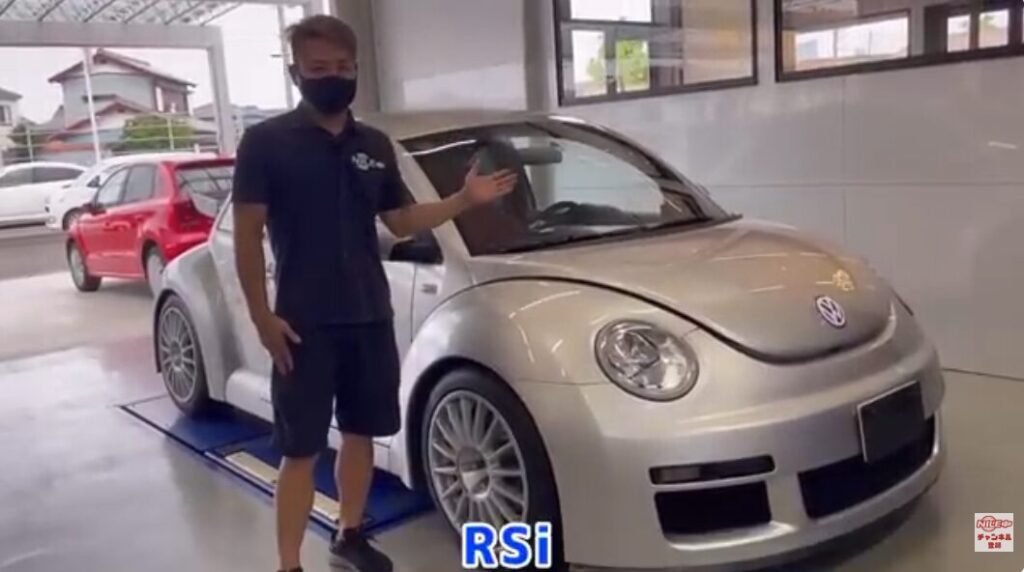
The New Beetle RSI, which debuted in 2001, is an extremely rare model, with only 250 units produced worldwide and only 45 officially introduced to Japan.
Planned as Volkswagen’s pride and joy, it was not simply a special edition, but a project in which the development department seriously pursued driving performance.
Due to the limited number of units, it is said to have sold out immediately after going on sale at the time, and today it is rare to even find it on the used market.
Its rarity is not simply a matter of numbers, but lies in the fact that it is a “culmination of technology” in which VW experimentally introduced next-generation technology.
The challenge behind the price of approximately 8.94 million yen
The new car price at the time was approximately 8.94 million yen,
an exceptionally high price for a mass-produced Beetle.
However, there was a reason for that price.
Most of the major parts were custom-designed, including the dedicated body, VR6 engine, 4WD, OZ wheels, carbon panels, and special bucket seats. Setting itself apart
from the cost-effectiveness of mass-produced cars, it was developed as a “semi-racing car” with many hand-made processes involved for each car.
As a result, it became a symbol of Volkswagen’s “pinnacle of the brand.”
A pioneer of the “premium hot hatch”
When the RSI was released in the early 2000s, the term “hot hatch” still referred to something between a sports car and an everyday car.
The RSI was a pioneering model that incorporated full-scale sports technology into the engine, chassis, and interior while still retaining a certain level of comfort.
Like the Audi TT and Golf R32, it had a major influence on later VW sports models.
The significance of making the design model “serious specifications”
The Beetle was originally a symbol of retro design, but the RSI overturned that “cuteness” and was born as a hard-hitting model that emphasized performance. Its
rounded body combined with wide fenders was revolutionary in that it combined cuteness with functionality.
It was the first Beetle to embody the concept of a “design car that can run,” and can be said to be a monumental car that established Volkswagen’s direction of combining design and driving performance.
Powertrain and drivetrain structure
3.2L VR6 engine layout and features
The engine installed in the New Beetle RSI is Volkswagen’s traditional 3.2-liter VR6 unit.
This engine has a unique 15° bank angle, which can be described as a “cross-section between a V-type and an in-line structure,” and employs a unique layout called a narrow-angle V6.
Despite its compact size, it is designed to combine the smoothness and power unique to a six-cylinder.
Although it is a naturally aspirated engine, it delivers a maximum output of 225 hp and a maximum torque of 32.6 kgm.
It produces substantial torque from the low rpm range, and at high rpm, it has a smooth feel similar to that of a straight-six. It
also has sharp response, and the analog “pleasant feeling of increasing rpm” that does not rely on electronic control stands out.
The significance of the compact V6 structure
A typical V6 engine has a bank angle of 60° or 90°, which makes a transverse layout difficult in terms of space.
However, the VR6 uses an extremely narrow angle of just 15°, which allows the overall width of the engine to be kept to the same level as an in-line four-cylinder engine.
As a result, it is possible to install a six-cylinder engine in a compact body like the Beetle, and a design with excellent weight balance has been achieved.
This structure, developed independently by Volkswagen, was a clever way to combine practicality and sporty performance at a high level.
6-speed manual transmission structure
The RSI comes standard with a 6-speed manual transmission, with gear ratios set to prioritize acceleration over high-speed cruising.
The short stroke and moderate shift feel were praised for being particularly precise, even among VW cars of the time.
The clutch is neither too light nor too heavy, with a good balance of pedal feel and operability, and is designed to accurately transmit the VR6 engine’s powerful torque.
The mechanical, direct feel of operation, from before electronic control became mainstream, is an appeal not found in today’s cars.
Control characteristics of the 4MOTION system (Haldex coupling)
The drive system is an electronically controlled 4WD “4MOTION”.
The system uses a Haldex coupling and is normally front-wheel drive, but when it detects a loss of traction it instantly distributes drive power to the rear wheels.
This control is almost mechanical, ensuring stable driving even on snowy or rainy roads.
Despite being a front-wheel drive vehicle, it has a very natural posture when cornering, allowing the driver to accurately trace the intended line.
This is not just for safety reasons, but also provides a “sense of security when stepping on the gas” during sporty driving.
Component commonality with Golf 4 R32
The RSI’s drivetrain and engine became the development basis for the Golf 4 R32, which was released later.
While the R32 was finished as a “mass-production sports model,” the RSI was designed as an “experimental precursor model,” so while many of the components were the same, the tuning was different.
The engine mounts, exhaust system, transmission ratios, ECU mapping, etc. were optimized specifically for the RSI, and even though it was the same VR6, its character was significantly different.
In other words, the RSI could be considered the “R model before the R32,” and was an important turning point in VW’s sports history.
Specially designed chassis and suspension
Rear multi-link structure
The New Beetle RSI uses a dedicated chassis structure that differs from the standard model of the time.
Its biggest feature is that, while based on the Golf 4 platform, it uses a multi-link system for the rear suspension.
This is not simply a reuse, but incorporates an arm structure designed specifically for the RSI, with the aim of optimizing drive force transmission and traction.
As a result, stability during acceleration is significantly improved, and behavior is natural and easy to control, especially in mid- to high-speed corners. It
can be said to be a pure sports design that sets it apart from the usual torsion beam structure.
Damping tuning with special dampers and springs
The suspension uses specially set dampers and springs, and the vehicle height is set approximately 20mm lower than the standard Beetle.
This lower center of gravity increases roll rigidity and reduces changes in posture during braking and cornering.
Furthermore, the spring rate and damping force have been tuned with an emphasis on high-speed stability, achieving a flat ride even on winding roads.
Rather than simply providing a stiff suspension, the focus has been placed on “flexible rigidity.”
The appeal of the RSI lies in its versatility, which allows it to be used on both the street and the circuit.
The purpose of the large-diameter shock absorber and increased rigidity
The RSI uses larger diameter shock absorbers, and the increased piston diameter allows for more linear control of the damping characteristics.
This provides a stable feeling of contact with the road even over small bumps in the road, resulting in a ride that is less tiring even on long drives.
In addition, reinforcing braces have been added to the subframe and arm mounting points to suppress twisting of the entire body.
In addition to improving rigidity, consideration has been given to allowing the suspension to perform its intended movement.
These designs not only enhance the sportiness of the vehicle, but also contribute to extending the vehicle’s lifespan.
Balance of reinforcing brace structure and body rigidity
The entire body has been reinforced from the A-pillars to the floor and rear section.
However, increasing rigidity too much can worsen ride comfort, so VW placed emphasis on balance.
A cross member was added to the center of the floor to increase local rigidity while maintaining overall flexibility.
This allows the suspension to move smoothly even on rough roads, and the steering feel is natural.
This “rigidity design that allows man and machine to interact” without being overly rigid is a concept that is still relevant in modern VW cars.
Brake settings suitable for street driving
The brakes use large ventilated discs, and the front and rear braking balance has been revised.
By making the initial braking a little gentler and setting it to be more effective from the middle of the pedal stroke, it has been possible to achieve controllability that is easy to handle even in everyday driving.
This is a design concept that emphasizes “performance for driving” as well as “reliability for stopping.”
The brake feel is comfortable for city driving, while still providing performance that is strong enough for circuit driving, proving that the RSI is “a practical vehicle, despite being a limited edition.”
Exterior design and aerodynamic treatment
Special wide fenders and widened body structure
The most eye-catching feature of the New Beetle RSI’s exterior is its specially designed wide fenders.
The body, which has been widened by approximately 80 mm both front and rear, is not simply the addition of aero parts, but rather a structure in which the body panels themselves have been redesigned.
A distinctive feature is that the fenders are not made of plastic, but are reshaped steel panels, achieving both design and rigidity.
This widening has widened the tread, significantly improving stability when cornering.
It has achieved a muscular and powerful silhouette while making the most of the Beetle’s rounded shape.
Unlike typical limited edition cars, the exterior changes are not merely decorative, but are established as a “functional design.”
Rear spoiler design for aerodynamic balance
The rear spoiler is also designed specifically for the RSI, ensuring downforce while minimizing air resistance during driving.
A round body shape is at a disadvantage aerodynamically, but VW conducted extensive testing to arrive at a shape that provides the rear end with an appropriate streamlining effect.
This improves straight-line stability at high speeds and reduces the feeling of instability that the rear is floating.
Furthermore, the aerodynamic effect is not overly emphasized, and the design blends in naturally, matching the aesthetics of the Beetle.
Reasons for using genuine OZ Racing 18-inch wheels
The RSI comes equipped with 18-inch forged wheels manufactured by OZ Racing as standard.
The 235/40R18 size provides an excellent balance between wheel rigidity and light weight.
Compared to regular cast wheels, this allows for a significant reduction in unsprung weight, improving suspension tracking and sharpening steering response.
In terms of design, the RSI features a multi-spoke design that makes a striking combination with the white-silver body color.
VW’s design philosophy is strongly reflected in the selection of parts that combine practicality with aesthetic beauty.
Body details that combine aerodynamics and functionality
RSI’s aero parts place more emphasis on the functionality of the details than on appearance.
The front bumper is equipped with large air ducts that improve brake cooling and engine intake efficiency.
The side skirts are shaped to regulate airflow under the body, reducing lift during high-speed driving.
The rear diffuser is also functionally designed, reducing exhaust interference while rectifying the rear airflow.
These elements work together to deliver aerodynamic performance that was exceptional for a commercially available car at the time.
The fact that design and performance are seamlessly integrated is proof that RSI was serious about design.
Interior material design and functional layout
Interior design that combines lightweight design with a high-quality feel
The interior of the New Beetle RSI has a completely different finish from that of the mass-produced Beetle.
The concept is “a fusion of racing spirit and luxury.”
While lightweight materials are used throughout, it is not simply a Spartan design, but maintains a high-quality texture.
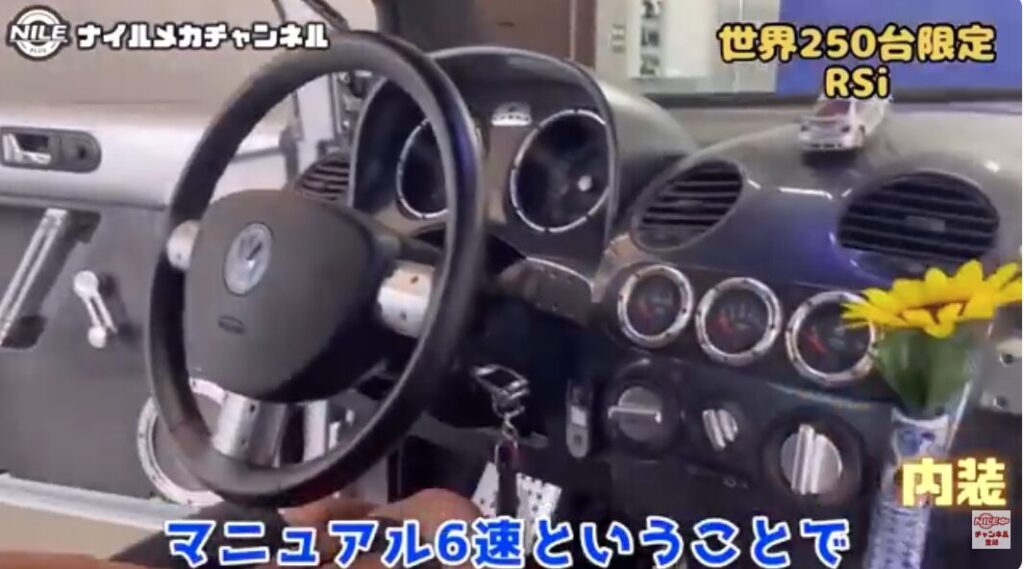
Many of the interior trims and panels are made of carbon or aluminum, which not only creates an impact but also contributes to weight reduction.
The entire interior is designed as a “space centered around the driver,” with functionality taking priority over decoration.
Effect of carbon door panels and aluminum console
The carbon fiber door panels, exclusive to the RSI, are lightweight and highly rigid.
This gives the doors a firmer feel when opening and closing, and reduces resonance while driving.
The center console uses machined aluminum trim.
It has a pleasant feel and is heat-resistant, ensuring comfort even during sporty driving.
By carefully selecting materials in this way, we have achieved an interior that is resistant to deterioration even in high temperatures and high-vibration environments, while preventing weight gain.
Design concept of full bucket seats and orange stitching
The most striking feature of the interior is the Recaro full bucket seat.
It has a flexible cushion structure that provides excellent support while also being able to withstand long-distance driving.
The upholstery is made of Alcantara, which is both breathable and abrasion-resistant.
The stitching uses bright orange thread, adding an accent to the gray-based interior.
This creates a unique atmosphere that exudes warmth even within the racing mood.
Just sitting in the seat gives you the exhilaration of knowing you’re in a special car.
Triple gauge (oil temperature, oil pressure, voltage) layout
A triple gauge is located at the top center, allowing you to check oil temperature, oil pressure, and voltage in real time.
This is important information when driving in a sporty manner, allowing you to instantly grasp the engine condition.
The layout is angled closer to the driver, minimizing eye movement.
While offering the practicality of a racing car, it is also beautifully designed as part of the interior.
The gauges are all illuminated in amber, making them highly visible even at night.
A fusion of Alcantara interior texture and sporty feel
Alcantara is widely used for the seats, steering wheel, shift boot, etc.
Its soft texture makes it comfortable and non-slip even during long drives, and it is also suitable for sporty driving.
The subdued texture, different from leather, envelops the entire cabin, further enhancing the exclusivity of the RSI.
This interior design, which is appealing not for its flashiness but for its “functional beauty,” is a symbol of Volkswagen’s philosophy of simplicity and robustness.
Functions and operability – the experience brought to you by VR6 sound
Starting process and engine sound
When you start the RSI engine, the first thing you notice is a deep, rich layer of sound.
The starter motor gives a short turn, and the VR6 engine immediately wakes up.
The idling sound is gentle, yet there is a sense of density, as if it is being tightly compressed internally.
When you lightly press the accelerator, the unique harmony of the six cylinders resonates as the rotations increase, and a “heavy, pleasant sound” spreads out, blending metallic high notes with low notes.
The natural exhaust sound, which is not produced by an electronically controlled muffler, truly gives the feeling that the machine is alive.
The unique exhaust sound of the VR6 and its appeal
The sound of a VR6 engine differs from that of a typical V6 or straight-six engine, with complex overtones created by uneven cylinder spacing.
This structure makes it quiet at idle, but as the rotation speed increases, a unique “thickness” is created, resulting in a smooth transition in the sound.
The exhaust line is also specially designed for RSI, and is designed to naturally bring out the contours of the engine sound.
The design prioritizes sound quality rather than volume, so your ears won’t tire even after long rides.
Balance of clutch feel and shift feel
The 6-speed manual transmission’s feel is a perfect blend of precision and rigidity, typical of a VW.
The clutch pedal is light when you first press it, with moderate resistance felt midway through, making it clear when the shift is engaged.
The shift lever has a short stroke and a clear click, making it fun to select gears.
Every action feels mechanical, with the feeling that there is a direct connection between the driver’s operation and the car’s response.
Unlike the electronically controlled smoothness of modern cars, the appeal of the RSI is that it gives you a strong sense of actually “controlling” the car.
Value seen in comparison with modern cars
Electronic torque management and drive mode settings are commonplace in the latest sports cars.
However, with RSI, the driver’s actions are directly reflected in the car’s behavior.
The clutch disengagement, accelerator pedal pressure, and gear selection all have a direct impact on the driving experience, so driving technique itself determines the driving experience.
This “sense of oneness with the machine” is a pure pleasure that is hard to find in modern cars, and it is what makes RSI so special.
RSI from the perspective of undercarriage structure and maintenance
Structural features visible during lift-up
When you lift up the RSI and take a look, you can see that it has a special design that is very different from the standard Beetle.
The first thing that catches your eye is the reinforcing plates and cross members that run under the floor.
The structure connects the front and rear subframes, and is designed to allow the suspension to move flexibly while suppressing twisting of the body.
The exhaust system also runs through a special route, using a stainless steel pipe structure with a resonance chamber in the center.
Even from a visual perspective, it is clear that this is a lean “undercarriage designed for driving.”
Suspension mounting structure and reinforcement plate
Reinforcement plates not found on the regular Beetle have been added to the mounting points of the rear suspension.
This reduces toe changes during acceleration, deceleration, and cornering, ensuring stable traction.
The arms are also made of steel and are designed with rigidity in mind. The bushings
are set to be slightly stiffer, absorbing vibrations while driving while still properly conveying road information to the driver.
The front subframe is also highly rigid, providing a quick response to steering input.
Overall, this build shows just how much VW car was conscious of driving performance at the time.
Maintainability and parts supply issues
The RSI’s unique undercarriage structure naturally requires unique maintenance precautions.
First of all, while many of the suspension and brake parts are common to the Golf 4 R32, there are some minor differences, so care must be taken when reusing them.
In particular, reinforcement plates and muffler stays are exclusive to the RSI, and the supply of genuine parts is extremely limited.
Some parts are no longer manufactured, so importing them from Europe or securing used parts is a realistic solution.
Therefore, to maintain the RSI for a long time, it is essential to inspect it regularly and keep a stock of parts.
Important points to note when maintaining this rare vehicle
Limited edition models like the RSI require careful handling when servicing.
For example, the jacking points are different from the standard model, and additional structure has been added to maintain the body’s rigidity.
Lifting the car in the wrong position could deform the reinforced parts.
Also, when cleaning the undercarriage or applying rust prevention treatment, care must be taken not to damage the paint film or coating.
Although the car is designed to be rust-resistant, exhaust system flanges and bolts are prone to corrosion in vehicles over 20 years old, so regular rust prevention maintenance is recommended.
To keep a rare RSI in working order, proper maintenance is just as important as running it.
State of preservation and value
The importance of maintaining original condition
The New Beetle RSI is highly valued as a collector’s car due to its limited production run of just 250 units worldwide.
Therefore, the most important thing is “how much of the originality has been maintained.”
In particular, many exterior and interior parts are not reproduced, and their value tends to decrease once they have been replaced or repainted.
Small scratches and aging in the paint are often valued as proof of the car’s originality, so it is advisable to avoid repainting unnecessarily and focus on maintaining its condition.
It is ideal to maintain its condition by cleaning it daily, storing it indoors, and starting it regularly.
Points to avoid when repainting or repairing
The exterior of the RSI is painted in a special color, “Silver Metallic (LA7W),” but the particle composition of this paint is special, and it is said to be difficult to perfectly reproduce with current general paint.
Repainting will result in subtle differences in the way light is reflected and the way the metal particles float, resulting in a difference in texture from the original.
Interior parts made of carbon or aluminum are also difficult to repaint, and improper surface treatment can damage the material itself.
When repairing, it is recommended to prioritize “keeping things clean” over partial repairs, and to minimize maintenance efforts.
Market value as a collector’s car
Since the 2020s, the market price of the RSI has been on the rise, especially in Europe.
With low-mileage examples sometimes going for over 10 million yen, it is now considered “the rarest production car in Volkswagen history.”
The reasons for this are its combination of a naturally aspirated VR6 engine and a 6-speed manual transmission, which cannot be replicated in modern cars, and its exquisite design.
Furthermore, as we now enter the age of electrification, the RSI’s analog mechanism is being reevaluated as a form of “cultural value.”
“Run and protect” – the philosophy of RSI owners
Preserving rare cars is not just about preserving them, but also about regularly “driving” them, which is directly linked to maintaining their condition.
Circulating engine oil and coolant prevents internal deterioration and keeps bushings and rubber parts flexible.
RSI owners value this idea of ”dynamic preservation,” and never miss starting their cars up or taking them for a short drive once a month.
Running maintains the car’s functionality, while at the same time passing on its value as “living history.”
This is the shared philosophy of RSI owners.
Preserving and driving are both forms of love, and the balance between these two is what true preservation is all about.
If you want to choose a high-quality VW with peace of mind
Nile Plus, a VW specialty store, handles carefully selected high-quality vehicles from all over the country, based on the policy of “only stocking Volkswagens that we would truly want to drive.”
From purchasing to delivery, all processes are handled responsibly by former VW dealer mechanics.
With inspections using dedicated testers, over 71 pre-delivery maintenance items, and a one-year warranty,
we offer the same peace of mind as domestically produced cars.
Can you find a car model that is not in stock?
Of course it is possible.
We utilize our nationwide network to sell made-to-order vehicles, allowing you to specify the exact grade and color you desire. We
will use our professional eyes to find and deliver your ideal vehicle.
▼ Nile Plus service details ▼
Visit the official Nile Plus website
Summary – “Serious construction” that remains unchanged even after 21 years
The “ideal brand” demonstrated by VW in the 2000s
The New Beetle RSI can be said to be a symbol of an era when Volkswagen still placed equal importance on “driving performance” and “design. “
The idea of combining a 3.2L VR6 engine and 4MOTION with the design-focused base car, the Beetle, was extremely bold even at the time.
The RSI is not just a limited edition model, but a development vehicle that embodies VW’s ideal of the “ultimate Beetle,” and is a symbol of the company’s technological capabilities and passion.
This car embodies the “coexistence of craftsmanship and rationality” that VW possessed in the early 2000s.
The appeal of analog performance without relying on electronic control
While modern cars use electronic controls and drive modes to change performance, the RSI’s performance was generated by its mechanical structure itself.
A 6-speed manual transmission that directly responds to the driver’s input, a 4MOTION system that is close to a mechanical system, and a naturally aspirated engine.
These combine to achieve a “linear driving experience” that is close to human sensations. This
model truly embodies “precision without electronic controls.”
This pure driving experience is a rare value that is hard to find in modern cars.
The preservation value of limited edition cars and the importance of maintenance
Not only are there few RSIs sold, but there are many specialized parts, so maintaining them requires specialized knowledge and effort.
Many parts, from the suspension to the exhaust system and interior panels, are exclusive to the RSI, so securing and restoring parts requires careful planning.
However, a properly maintained RSI will retain its performance over time, and its rarity will continue to increase its asset value with each passing year.
The concept of “dynamic preservation,” which involves maintaining the condition of a car by driving it moderately while cherishing its original condition, will become increasingly important in the future.
The New Beetle RSI shows “Volkswagen passion”
The RSI is a car that proves that Volkswagen is not just a mass-market car manufacturer, but a “group of craftsmen who create the ideal car.”
Based on a design car, this model combines serious driving performance with a racing feel, and is highly acclaimed beyond the bounds of time.
Even after 21 years, its craftsmanship and philosophy have not faded, and it can be said to have made a significant impact on modern car manufacturing.
The New Beetle RSI continues to shine in Volkswagen history as the crystallization of “playfulness created with sincerity.”
Introducing the Monster New Beetle RSi, limited to 250 units worldwide!

Frequently Asked Questions (FAQ)
Q1. Can RSI be used on a daily basis?
A. Mechanically, it is possible, but considering the risk of wear on rare parts, it is more suited to weekend drives than daily use. We
recommend limiting driving to a few times a month and focusing on preserving the car in working order.
Q2. What is the difference between the Golf R32?
A. The basic structure is similar, but the RSI is a prototype, lighter and sharper.
The exhaust system, ECU, body reinforcement, etc. have been tuned specifically for the RSI.
Q3. Are parts available?
A. Some parts are shared with the R32 and TT, but many interior and exterior parts are exclusive to the RSI.
At the moment, the main way to obtain them is to import used parts from Europe.
Q4. How much does it cost to maintain?
A. It depends on the condition, but you can rest assured that you can expect to spend around 100,000 to 200,000 yen per year for regular maintenance and preventative maintenance.
Maintenance of the suspension and oil system is especially important.
Q5. What should I pay attention to when considering a purchase?
A. Be sure to check for repair history, whether it has been repainted, whether there are any missing interior parts, etc.
A car that has all of its original parts will have an advantage in terms of maintaining its value in the long term.
The RSI is a rare car that combines performance with aesthetic beauty.
It continues to fascinate many fans as a “living masterpiece” that responds to the amount of work you put into it.



コメント